Audio version of the article: handy on the go, while cooking, or on a walk.
{“@context”:”https://schema.org”,”@type”:”AudioObject”,”name”:”Тарелка здоровья — идеальные пропорции БЖУ”,”description”:”Голосовая версия статьи.”,”contentUrl”:”https://hervibehub.site/wp-content/uploads/2026/10/podcast-tarelka-zdorovya-bzhu.mp3″,”encodingFormat”:”audio/mpeg”,”duration”:”PT10M15S”}
What Is the “Healthy Plate”
The “Healthy Plate” (or the “plate method”) is a simple, visual way to build a balanced meal without counting calories or grams. It was developed at the Harvard School of Public Health, and since then the approach has spread around the world — precisely because it works.
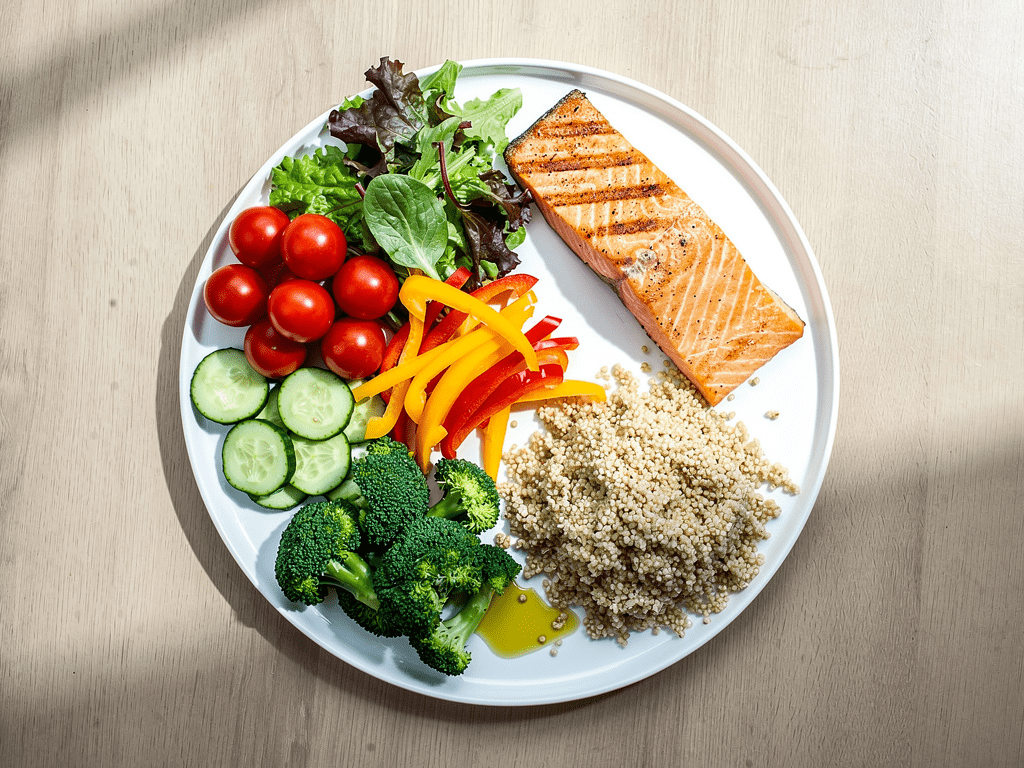
The idea is simple: you take a regular plate (22–24 cm in diameter) and mentally divide it into three parts. Half is filled with vegetables and greens, a quarter with protein, and another quarter with complex carbohydrates. Add a bit of healthy fats — and you’ve got the perfect lunch.
No scales, no apps, no math. Just common sense that helps you eat with variety, stay full, and avoid unnecessary restrictions.
Ideal P/C/F Ratios: What Science Says
P/C/F stands for proteins, carbohydrates, and fats. The three macronutrients that make up absolutely any food. Their balance determines how we feel, how much energy we have, how our metabolism works, and even what kind of mood we’re in.
Protein — 25–30% of your diet
Protein is the building material. The body uses it to create muscles, skin, hair, enzymes, and antibodies. Without enough protein, your metabolism slows down, you feel constantly tired, and your skin loses its elasticity.
How much do you need? A good target is 1.2–1.8 grams per kilogram of body weight. A woman weighing 60 kg needs about 72–108 g of protein per day. On a plate, that looks like a piece of fish, chicken breast, or a portion of tofu the size of your palm without fingers.
Best sources: chicken fillet, turkey, fish (especially fatty fish — salmon, mackerel), eggs, cottage cheese, Greek yogurt, tofu, lentils, chickpeas, beans.
Fats — 20–30% of your diet
Fats have been rehabilitated. We no longer fear butter and avocado — and rightly so. Healthy fats are essential for hormone synthesis (including female hormones — estrogen and progesterone), absorption of fat-soluble vitamins A, D, E, K, and nervous system health.
How much do you need? About 1 gram per kilogram of body weight. For a 60 kg woman — around 60 g of fat per day. On a plate, that’s a tablespoon of olive oil, a quarter of an avocado, or a handful of nuts.
Best sources: extra virgin olive oil, avocado, nuts (walnuts, almonds, cashews), seeds (flax, chia, pumpkin), fatty fish, egg yolk.
What to avoid: trans fats (margarine, fast food, industrial baked goods) and overheated vegetable oils. They are genuinely harmful and trigger inflammation.
Carbohydrates — 45–55% of your diet
Carbohydrates are the main source of energy. The brain consumes about 120 g of glucose per day, and if you’ve ever tried a low-carb diet, you know what “carb fog” feels like — when your head just won’t work and you don’t even have the energy to get off the couch.
The whole trick is which carbohydrates you eat. Simple ones (sugar, white flour, sweets) give you a quick energy spike followed by a sharp crash. Complex ones (whole grains, legumes, vegetables) release energy slowly and keep you going for hours.
Best sources: buckwheat, slow-cooked oats, quinoa, brown rice, whole-grain bread, durum wheat pasta, potatoes (especially cooled — they develop resistant starch), legumes, fruits, and vegetables.
How to Build a “Healthy Plate” in 5 Minutes
A practical step-by-step guide:
Step 1: The Vegetable Base (50% of the plate)
Half the plate is filled with vegetables — fresh, roasted, stewed, or steamed. The more color variety, the better: green (broccoli, spinach), red (tomatoes, peppers), orange (carrots, pumpkin), purple (eggplant, red cabbage). Each color equals its own set of vitamins and antioxidants.
The rainbow rule: aim for three different colors in every meal. It’s not just about making a pretty picture — it’s a guarantee that you’re getting the full spectrum of micronutrients.
Step 2: The Protein Focus (25% of the plate)
A quarter of the plate is a protein food. A portion roughly the size of your palm (without fingers). Rotate your sources: fish today, chicken tomorrow, legumes the day after. Variety equals a complete amino acid profile.
Step 3: The Carb Side (25% of the plate)
The remaining quarter is complex carbohydrates. A portion about the size of your fist. Buckwheat, quinoa, brown rice, roasted sweet potato, whole-grain pasta. Don’t be afraid of potatoes — they’re not the enemy, especially when cooled (resistant starch works as a prebiotic).
Step 4: The Fat Finishing Touch
Healthy fats are added as a finishing touch: drizzle vegetables with olive oil, toss a handful of seeds into your salad, or add a slice of avocado. It’s not part of the “quarters” — it’s an important addition that makes the dish tasty and helps your body absorb vitamins.
Examples of “Healthy Plates”
Breakfast: a two-egg omelet with spinach and tomatoes (protein + vegetables) + whole-grain toast with avocado (carbs + fats).
Lunch: baked chicken breast (protein) + quinoa (carbs) + mixed salad with cucumbers, peppers, and olive oil (vegetables + fats).
Dinner: salmon steak (protein + fats) + roasted broccoli and cauliflower (vegetables) + a spoonful of hummus (carbs from chickpeas).
Snack: Greek yogurt with berries and a handful of walnuts — a mini plate built on the same principle.
Why This Works Better Than Diets
Diets are a temporary measure. They create a deficit and stress, and when the diet ends, the weight comes back (often with extra). The “Healthy Plate” is not a diet. It’s a way of thinking that becomes automatic.
Five reasons to choose the plate method over a diet:
- No forbidden foods. Nothing is “off-limits” — it’s a matter of proportions. Craving pizza? Fine, just pair it with a big serving of salad and the balance is restored.
- No counting required. Your eye adjusts to the proportions within a couple of weeks. After that — autopilot.
- Flexibility. The method works anywhere: at home, in a restaurant, at a food court. Even a buffet can be assembled using the plate principle.
- Variety. You’re not tied to specific foods. Buckwheat today, bulgur tomorrow, quinoa the day after — the plate gets along with every cuisine in the world.
- Sustainable results. By eating according to the plate method, you naturally land on ideal P/C/F ratios — about 25% protein, 25% fat, and 50% carbs — without a single calculation.
Common Mistakes and How to Fix Them
“I eat lots of vegetables, but I’m not losing weight.” Check your dressing. Mayonnaise and store-bought sauces can turn a healthy salad into a calorie bomb. Dress with olive oil, lemon juice, balsamic vinegar, or Greek yogurt with herbs.
“Protein is only meat.” A misconception. Legumes, tofu, eggs, and dairy are complete protein sources. Combine plant and animal sources for maximum benefit.
“Fruit = unlimited healthy snacking.” Fruit contains fructose, and in large amounts (more than 2–3 servings a day) it can interfere with weight loss. That doesn’t mean you need to cut it out — just keep portions in mind.
“Steamed vegetables every day.” Roast them, stew them, grill them, eat them raw, blend them into smoothies. Variety in cooking methods saves you from boredom and expands your diet.
P/C/F for Different Goals
Weight loss: slightly more protein (30%), slightly fewer carbs (40%), fats unchanged (30%). Protein preserves muscle, and a small carb deficit creates a comfortable calorie shortfall.
Muscle gain: protein 25–30%, carbs 50–55% (emphasis on complex), fats 20%. Muscles are built from protein, but the energy for training comes from carbs.
Weight maintenance: the classic formula 25/25/50 or 30/25/45. Whichever feels more comfortable is yours.
Pregnancy and lactation: protein up to 30%, fats up to 30% (especially omega-3 for the baby’s brain development), carbs 40%. Always consult your doctor — individual needs may vary.
Where to Start Today
- Buy a plate of the right size. A 22–24 cm diameter is a standard dinner plate, not a platter. A little trick: on a big plate, portions look smaller, and your brain asks for seconds.
- Try one meal a day. Don’t overhaul your entire menu at once. Start with lunch — the most stable meal of the day. Build it according to the plate rule. After a week, add dinner.
- Keep “lifesavers” on hand. Frozen vegetable mixes, canned beans, eggs, and whole-grain crispbread — this is a base from which you can assemble a healthy plate in 10 minutes, even when the fridge is nearly empty.
- Don’t chase perfection. 80% of plates by the rules, 20% — free mode. Birthday cake and pizza with friends are a normal part of life. The “Healthy Plate” is a tool, not a religion.
Quick Reference: The “Healthy Plate” Cheat Sheet
- 🥗 Half the plate — vegetables and greens. The rainbow rule: 3 colors in every meal.
- 🍗 A quarter — protein. A palm-sized portion: fish, poultry, eggs, legumes, tofu.
- 🍚 A quarter — complex carbs. A fist-sized portion: buckwheat, quinoa, brown rice, sweet potato.
- 🫒 A touch of fat. A spoonful of oil, a handful of nuts, a slice of avocado.
- 💧 Water. A glass before the meal and a glass after — a simple habit that improves digestion and helps prevent overeating.
Eating well isn’t complicated. It’s a matter of habit. Give yourself three weeks, and the plate method will become as natural as brushing your teeth in the morning.