


You’re thirty, and sex is no longer something you thought about constantly. This isn’t “something broke” – it’s statistics. For most women after 30, libido dips for several years: kids, work, sleep deprivation, and hormones all take their toll. The good news is that desire doesn’t disappear forever – it just falls asleep, and it can be woken up.

A woman’s desire is a tender, illogical thing. It gets snuffed out by stress faster than the weather changes: unwashed dishes, an unfinished report, and a child who fell asleep just half an hour ago kill libido more effectively than anything else. Below is what actually works – no dubious “feminine practices” or internet pills.
In short:
– 4 out of 10 women experience a drop in desire after 30 – it’s normal, not an illness
– The main libido killers: stress, sleep deprivation, fatigue, and unresolved arguments
– The psyche responds to self-care, not technique – sex starts with an empty evening
Why desire drops after 30
Libido isn’t a button – it’s the sum of three things: hormones, nerves, and relationships. After thirty, women’s testosterone levels also start to decline, but the main enemy isn’t hormones – it’s accumulated fatigue.
When you’re constantly in “deadline – kid – cooking – deadline again” mode, the brain shuts down anything not related to survival. Desire is a luxury for the nervous system, and a tired brain cuts it off first.
The second reason – and the most underestimated one – is quiet resentment. Sex in a couple doesn’t die in the bedroom; it dies in the kitchen, when you ask for the third time for the trash to be taken out and no one hears you. What goes unsaid piles up and turns into “I don’t want to,” even though you don’t even understand why.
Do this: if your desire vanished suddenly and without reason, get your hormones checked (TSH, prolactin, ferritin). These are real medical causes.
Don’t do this: don’t chalk it all up to “the love is gone” until you’ve checked the physical side.
Sleep – the foundation desire starts from
Libido is directly tied to sleep. Chronic sleep deprivation lowers testosterone and raises cortisol – the stress hormone that kills arousal at the root. If you’ve been sleeping less than seven hours for three months straight, expecting libido is pointless.
A woman needs at least seven to eight hours of sleep for her nervous system to recover. And this isn’t “if possible” – it’s the baseline: without sleep, nothing else works – not hormones, not mood, not desire.
Do this: go to bed an hour earlier for three evenings in a row and see how your mood shifts. Sometimes that alone is enough.
Don’t do this: don’t scroll on your phone until 2 a.m. with “just five more minutes” – blue light disrupts melatonin, and you lie there with a tired body and a switched-off mind.
Stress – the main libido off-switch
Cortisol and libido are enemies. When you’re under chronic stress, the body freezes in “survive” mode, and sex becomes an unaffordable luxury. First you need to get out of stress, and only then work on intimacy.
What helps fastest, scientifically proven:
- Movement. 30 minutes of walking or light exercise a day noticeably lowers cortisol within two weeks
- Breathing. Five minutes of slow belly breathing (inhale for four counts, exhale for six) lowers your heart rate within three minutes
- Quiet. 10 minutes without your phone or news in the evening – your brain needs a break
- A to-do list on paper. Unloading tasks from your head onto paper reduces anxiety about the future
Do this: start with just one thing – a walk. It’s the simplest, and the effect shows up fastest.
Don’t do this: don’t try to “just relax” – relaxation doesn’t come on command while your body is still tense.
Talking to your partner without sounding like blame
Most often, desire fades not because of you alone but because of the couple’s dynamic. If sex has turned into a chore or a point of tension, the body honestly says “no.” And a conversation is needed – but not the kind that starts with “you don’t want me at all.”
The formula is simple: talk about yourself, not about him. Instead of “you stopped caring about me” – “I get so tired that by evening I have nothing left for anything, and it makes me sad.” That’s not weakness; it’s precision, and your partner hears it better.
Do this: pick a calm moment, no phones, at least an hour before bed. One conversation about feelings works better than ten hints.
Don’t do this: don’t bring the topic up in the middle of a fight – at that moment, no one hears anyone.
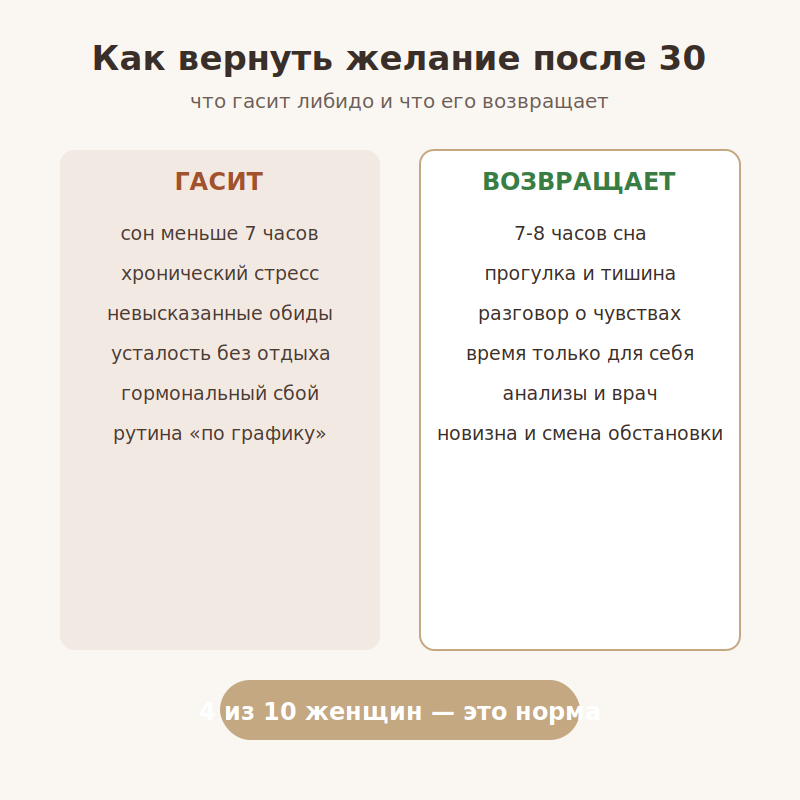
Let’s compare: what kills desire and what brings it back
| What kills it | What brings it back |
|---|---|
| Less than 7 hours of sleep | 7-8 hours of steady sleep |
| Chronic stress and deadlines | A walk and evening quiet |
| Unspoken resentments | Talking about feelings, not blame |
| Fatigue without rest | Regular time just for yourself |
| Hormonal imbalance | Tests and a doctor, not self-medication |
| Routine and “on schedule” | Unexpected little things and a change of scenery |
Checklist: 7 steps to bring desire back in a month
- Fix your sleep. Seven to eight hours for three weeks straight, phone out of the bedroom after 11 p.m.
- Get tested. TSH, prolactin, ferritin, vitamin D – this is the baseline worth checking once a year.
- Remove one source of stress. Delegate one task, close one long-pending issue.
- Add movement. Three 30-minute walks a week – the minimum for hormones.
- Talk to your partner. One honest conversation about feelings, no accusations.
- Bring back no-goal tenderness. Hugs and touch just because, with no “follow-up” – this relieves the pressure.
- Add novelty. A change of scenery, an unexpected little thing, breaking the routine – the brain responds to new things more sharply.
Tenderness without a “follow-up”: why it matters more than technique
The most common mistake couples make after losing closeness is that they stop touching each other unless sex is planned. Hugs, caresses, a kiss with no agenda disappear first, and everything else dies after them.
The physiology here is simple: tactile contact triggers oxytocin production – the hormone of attachment and trust. It doesn’t lead directly to arousal, but without it, arousal doesn’t kick in for most women. Trust first, then desire – in that order, not the reverse.
That’s why bringing back tenderness for its own sake isn’t a “bonus” – it’s a required step. The body has to stop reading every touch as a signal that “sex is about to happen.” When the pressure lifts, desire returns on its own – a paradox that works for most couples.
Do this: hug, hold hands, kiss with no agenda – daily, in small ways. Notice how your mood shifts after a couple of weeks.
Don’t do this: don’t push touch away with “I’m not in the mood for that right now” – pace it, but don’t cut contact off entirely.
Frequently asked questions
Is a drop in libido after 30 normal?
Yes, it’s normal. Four out of ten women experience a noticeable drop in desire after thirty due to fatigue, hormones, and load. It’s only a problem if it lasts more than six months and bothers you.
When should I see a doctor?
If desire vanished suddenly, with no visible cause, or is accompanied by dryness, fatigue, and mood swings. Start with a general practitioner or gynecologist and ask for a referral for tests.
What tests should I get for low libido?
TSH, prolactin, ferritin, vitamin D, and sex hormones as prescribed by a doctor. It’s a cheap and fast way to rule out physical causes.
Does stress really lower desire, or is that an excuse?
It really does. Cortisol – the stress hormone – directly suppresses sexual desire. It’s physiology, not laziness.
How do I bring desire back without a partner?
Sleep, movement, lowering stress, and a hormonal check work even without a couple. Libido is about your body, not only about relationships.
How long does it take for desire to come back?
With proper sleep and rest, the first shifts show up in two to four weeks. Hormonal correction takes a month or more, as prescribed by a doctor.
Verified: data on the link between sleep, stress, and libido comes from WHO materials and endocrinology guidelines. The test names are standard screening, prescribed by a doctor. Author: HerVibeHub editorial team.
The bottom line is simple: desire after thirty doesn’t die – it goes into hibernation while you’re surviving without sleep and rest. Start small and start with yourself, not with “fix me.” There’s just one question left – which item on this list will you do tonight so that in a month you won’t remember how it used to be?


