


Blazer in Fall: How to Wear Old Money and Not Look Like You Borrowed Someone Else’s Jacket
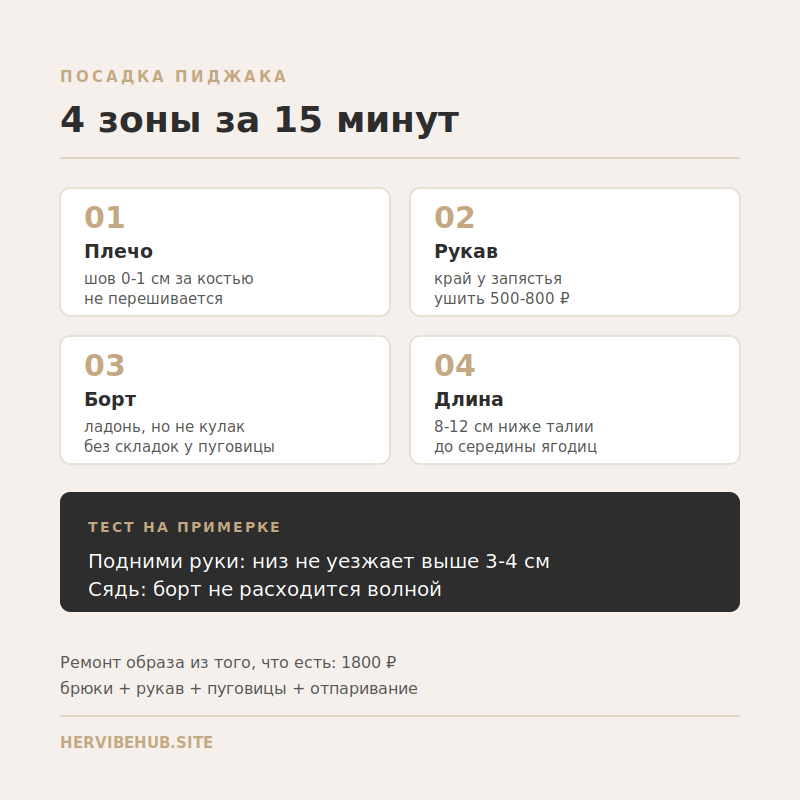
A blazer fits well when the shoulder seam sits 0–1 cm past the shoulder bone, the sleeve ends at the wrist, and the front doesn’t pull into folds at the button. Everything else — color, fabric, styling — is secondary. A blazer you “have nothing to wear with” is almost always just the wrong size: it can be saved with a 15-minute fitting and one trip to the tailor.
In short:
– The shoulder is the only area that’s almost impossible to alter. Check it first
– Sleeve shortening costs 500–800 ₽, jacket hem — 700–1200 ₽
– In fall, a blazer works with three layers: a top, thin knitwear, a shirt. One blazer = 7 outfits
– A cheap look is betrayed by three things: sleeve length, a wrinkled back, and a bag that’s the wrong scale
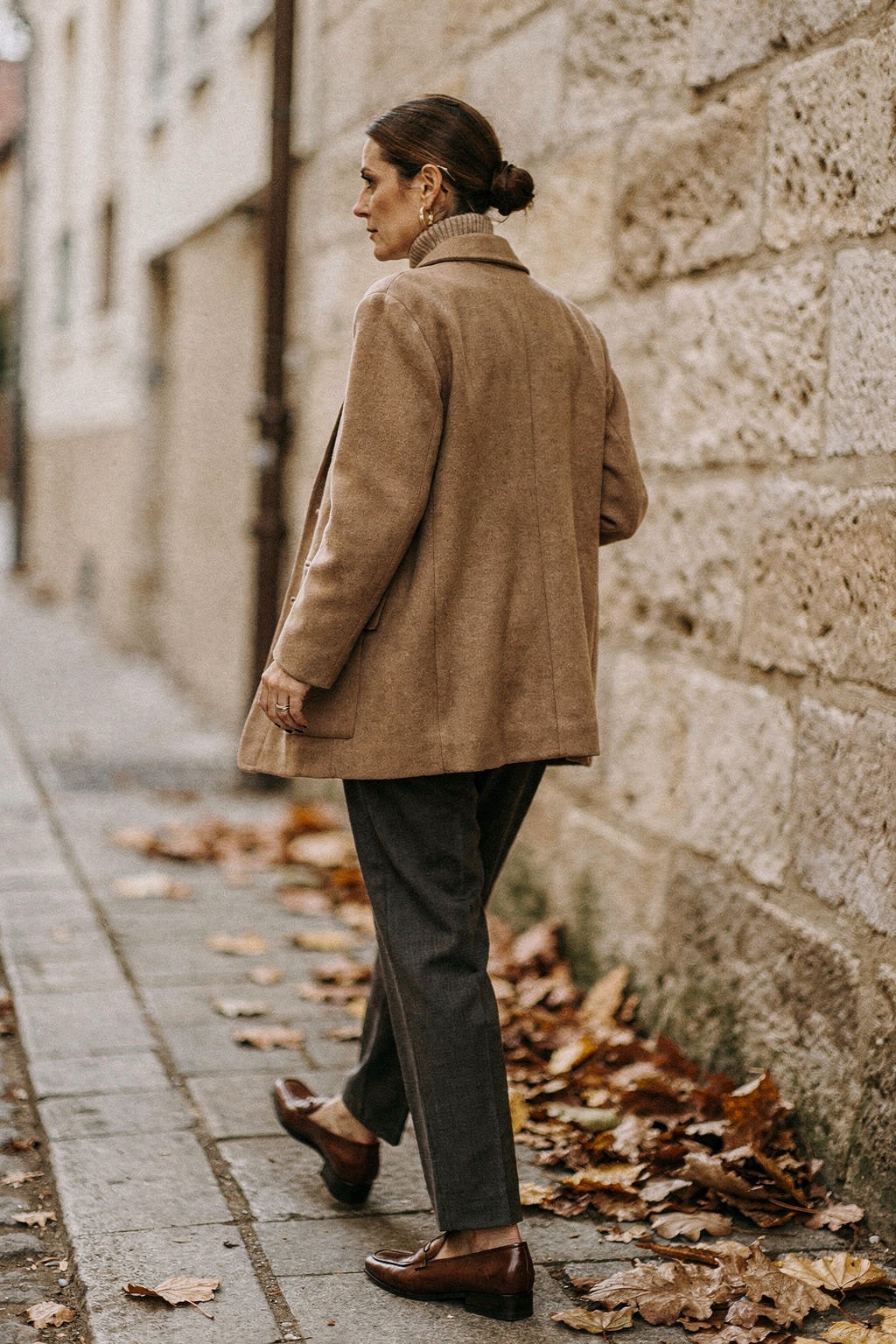
Why One Blazer Looks Expensive and Another Doesn’t: 6 Details
An expensive look isn’t created by the brand — it’s geometry and care. Here’s what gets noticed first.
- Shoulder. The seam runs exactly along the bone or 1 cm past it. If the seam has slid onto the arm — the blazer is too big; if the bone bulges under the fabric — it’s too small.
- Front. A buttoned blazer lies flat. A palm fits between the front and the body, but not a fist.
- Sleeve. The shirt cuff or wrist shows 1–1.5 cm. A sleeve covering the knuckles ages the look by five years.
- Lining. It doesn’t peek out from under the hem and doesn’t pull the fronts. Lining showing 3 cm is the most common reason for a “cheap” look.
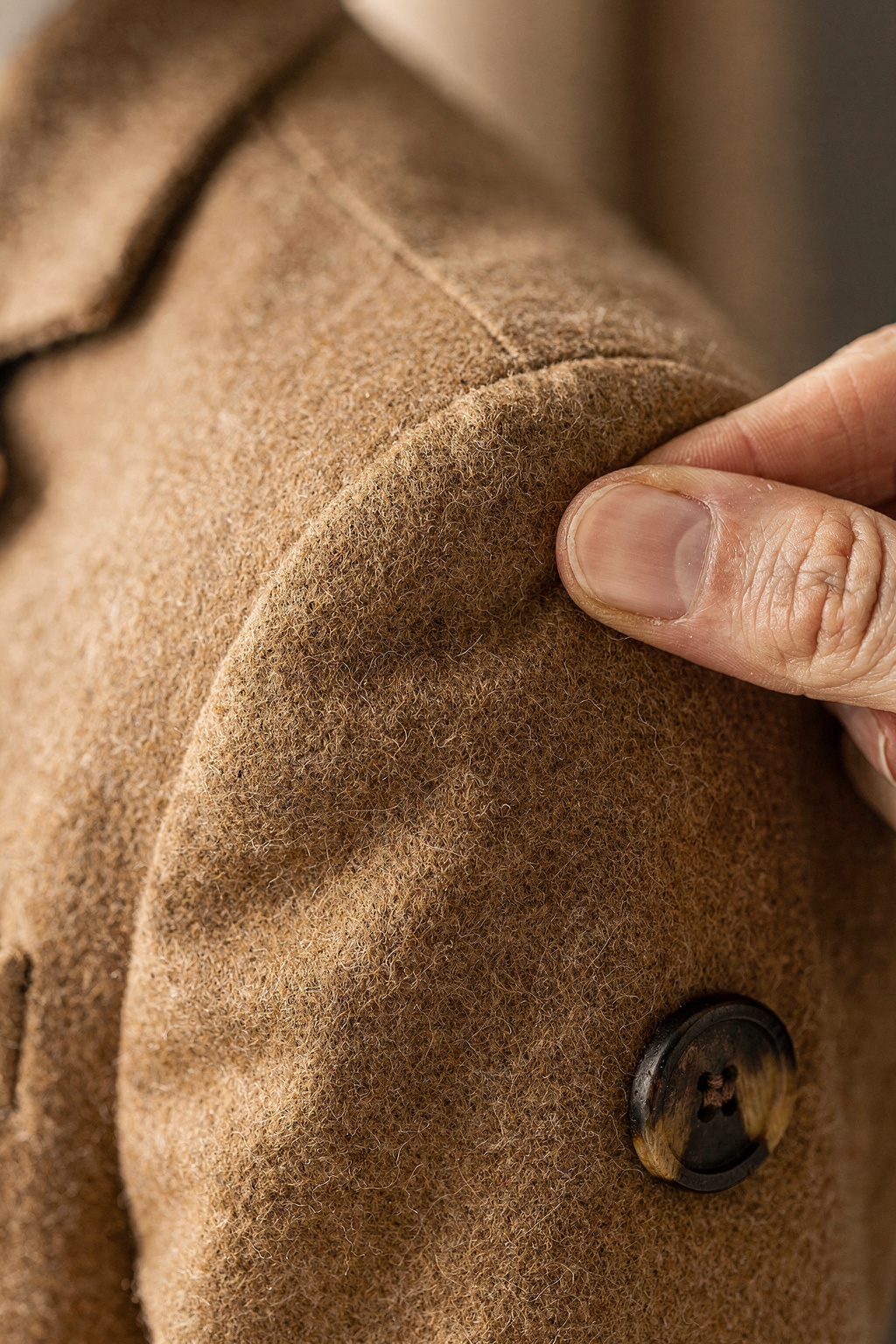
- Buttons and buttonholes. Buttonholes are stitched tightly, with no loose threads. Buttons aren’t sewn on with just two threads but with a “stem” — that way the front doesn’t pucker.
- Steamed look. A wrinkled back and creases at the elbows cancel out any price tag.
Do this: before heading out, run through these six points in a minute in front of a full-length mirror. Don’t do this: don’t judge the fit while sitting or from a phone photo — the angle lies, especially about sleeve length.
How to Check That a Blazer Fits: 4 Zones in 15 Minutes
A fitting isn’t “twirling in front of the mirror” — it’s five specific movements. Each one reveals its own zone.
- Put on what you’ll wear it with. Thin knitwear and a shirt take up different volume. A blazer that’s perfect over a t-shirt may not button over a sweater.
- Raise your arms up. The blazer hem shouldn’t rise more than 3–4 cm. If it jumps up 10 cm — the armhole is too small, and that can’t be fixed by a tailor.
- Stretch your arms forward, as if holding a steering wheel. The fabric on the back pulls into an “X” — it’s too tight across the back; there should be 2–3 cm of ease between the shoulder blades.
- Button the blazer and sit down. The front doesn’t gape in a wave, the hem doesn’t ride up to your throat. Folds spreading at the button — a signal to go up a size or choose a different cut.
- Stand in the blazer for 5 minutes. Weight and pressure under the arms don’t show up right away, only after walking around the store.
Do this: try it on over your own clothes and with your own bag. Don’t do this: don’t buy a blazer “for when I lose weight” — it won’t fit even after 5 kg, because the problem is usually in the shoulder, not the waist.
What Length Should the Blazer and Sleeve Be?
The classic length is the hem 8–12 cm below the waist, roughly to the middle of the buttocks. A cropped blazer ends 3–5 cm below the waist and pairs well with high-waisted trousers. An elongated one — 15–20 cm below the waist, worn with straight-leg trousers and jeans.
Sleeve: the edge at the base of the thumb or 1 cm above the wrist bone. The check is simple — bend your arm. If the sleeve rides up 3 cm and exposes the full width of the cuff, it’s too short. If it bunches like an accordion at the wrist — it’s too long, shorten by 1–2 cm.
The shoulder in a relaxed cut extends 3–6 cm past the bone — that’s intentional, not a mistake. But the volume should hold its shape: if the fabric sags down from the shoulder like a “roof,” the blazer is simply too big.
Do this: measure your go-to blazer with a tape measure from the shoulder seam to the hem and write down the number — it makes choosing in the fitting room easier. Don’t do this: don’t rely on the “to the knuckles” or “by the palm” rule — people have different arm lengths.
What to Wear a Blazer With in Fall: 7 Outfits From What You Already Have
One blazer covers the whole week if you switch up the three layers underneath and the shoes. Below are working combinations for weather from +15 to +5.
| Outfit | Bottom | Shoes | Weather |
|---|---|---|---|
| Office | Straight-leg trousers, top | Loafers | +10…+15 |
| Department store | Straight jeans, t-shirt | Sneakers without logos | +12…+18 |
| Lunch | Slip dress | Ankle boots | +8…+15 |
| Walk | Joggers in thick knit | Sneakers | +10…+16 |
| Theater | Midi skirt, thin turtleneck | Knee-high boots | +5…+12 |
| Travel | Leather trousers, sweater | Chunky boots | 0…+10 |
| Home office | Suit shorts or trousers, tank top | Mules | +18…+22 |
Do this: keep the blazer unbuttoned in looks with a t-shirt and knitwear, and buttoned — with a dress and skirt. Don’t do this: don’t button the blazer on the last button — the bottom one always stays open; that’s a rule, not a matter of taste.
How to Put Together an Old Money Look Without Shopping: 5 Steps
Old money isn’t logos or cashmere for 60,000 ₽. It’s a calm palette, clothes that fit, and minimal details — from what’s already hanging in your closet.
- Pick two neutral colors. Beige + graphite, gray + cream, navy + white. The third color — only in shoes or a bag.
- Remove anything shiny. Sequins, large logos, gold hardware — save them for another look. Keep matte textures: wool, cotton, leather.
- Check the trouser length. The hem of your trousers shouldn’t bunch up like an accordion over your shoes. Hemming costs 400–700 ₽, and it changes the look more than a new item would.
- Match shoes to the bottom. Loafers or plain boots cover 80% of cases. Sneakers — only clean and solid-colored.
- Add one thing that’s “not from the mass market.” A leather bag, a watch, a scarf. One detail, not three.
Upgrade budget for a look from what you already have:
Hem trousers            500 ₽
Shorten sleeve          600 ₽
Replace 6 buttons       400 ₽
Steaming at a tailor    300 ₽
Total                   1800 ₽ for a "15,000 ₽" look
Do this: repairs and care first, then shopping. Don’t do this: don’t buy a third blazer while the first two don’t fit properly.
What Makes a Look Cheap: A 7-Point Checklist
A cheap look is a set of small mismatches, each visible on its own. Check yourself against the list.
- The sleeve covers half the hand or ends 3 cm above the wrist
- The blazer is buttoned on the bottom button
- Under the blazer is a wrinkled t-shirt with a stretched-out collar
- Trousers bunch up in folds over the shoes
- The bag is much smaller or much larger than the scale of your figure
- More than three colors in one look
- Creases from storing on the back of a chair
Do this: remove one item at a time, starting with the sleeve — it’s the most noticeable area. Don’t do this: don’t try to fix everything in one evening; results come from consistency.
How to Care for a Blazer in Fall: Rain, Pilling, Storage
Fall kills blazers faster than wear: rain, public transport, temperature swings. Three rules extend the life of a garment by years.
After rain, don’t dry the blazer on a radiator. Hang it on 40–45 cm wide hangers in a room for 2–4 hours — wool releases moisture on its own. Remove pills with a fabric shaver every two weeks, not a razor: a razor cuts the fibers and leaves bald spots. In a plastic bag, the fabric can’t breathe and develops a musty smell within a month.
Check the composition on the label: according to GOST 25295-2003, blazers belong to the coat-and-suit category, and composition labeling is mandatory. If polyester makes up more than 60%, shine will appear at the elbows.
Do this: steam the blazer once a week with a vertical steamer, without touching the fabric. Don’t do this: don’t iron the blazer without a pressing cloth — shiny marks on wool can’t be removed.
Verified: Fit and care standards — tailoring practice; repair prices — from Stavropol workshop price lists for October 2026. Author: HerVibeHub team.
Frequently Asked Questions
How do I tell if a blazer is too big without leaving the fitting room?
Button it and try to slip a fist between the front and your body. If it goes through easily — it’s too big. If only a palm fits — the size is yours.
Can a blazer be taken in at the shoulders?
Almost never. Reshaping the shoulder costs from 3000 ₽ and often ruins the fit. The shoulder is the only area you choose, not fix.
How much does it cost to shorten a blazer sleeve?
500–800 ₽ if the sleeve has no functional buttonholes. With buttons on the sleeve — from 1200 ₽, because the buttonholes have to be moved.
What blazer should I wear with jeans?
A relaxed cut, length to the middle of the buttocks, matte fabric without shine. Straight jeans without distressing and shoes without large logos.
Can a blazer be worn without a shirt?
Yes, with a thick t-shirt or top. Check the neckline when bending over and sitting down: part of your underwear near the armhole shouldn’t be visible.
How often should I take a blazer to the dry cleaner?
2–3 times a season when wearing it 2–3 times a week. More often isn’t necessary: solvents wear out wool faster than regular wear.
What should I do if a blazer smells damp?
Air it out for 4–6 hours on a shaded balcony and steam it. Vinegar and perfume don’t remove the cause — the smell will return the next day.
Where to Look Next
If your wardrobe is already built but outfits don’t come together, start with the basics: capsule wardrobe: how many items you actually need. It breaks down which 12–15 items cover a season and how they combine with each other — a blazer in such a capsule usually plays the role of the third layer.


