Your back starts aching by lunchtime. Your shoulders roll forward on their own, like you’re hauling an invisible backpack full of bricks. And by evening, the only thing you want is to collapse face-first into the couch. Sound familiar? Here’s a spoiler: it’s not about “hard work.” It’s about your body forgetting how to hold itself upright. And no, this isn’t about your mom’s “straighten your back” from fifth grade. This is about 10 minutes a day that will genuinely rebuild your posture — no gym, no trainer, and no “I’ll just stand against the wall for half an hour.”
In short:
– A sore back isn’t fatigue — it’s weak core muscles and a tilted pelvis
– 10 minutes a day is enough: 5 exercises that work faster than a massage
– A rigid brace and a “magic” magnetic patch won’t save you — only movement will
Audio version of the article: perfect for the road, while cooking, or on a walk.
{“@context”:”https://schema.org”,”@type”:”AudioObject”,”name”:”Осанка за 10 минут в день: 5 упражнений для спины без зала”,”description”:”Голосовая версия статьи.”,”contentUrl”:”https://hervibehub.site/wp-content/uploads/2026/10/podcast-osanka-za-10-minut-v-den.mp3″,”encodingFormat”:”audio/mpeg”,”duration”:”PT10M33S”}
Why your back hurts not from work, but from not moving
A desk job isn’t a death sentence. A death sentence is eight hours in the shrimp pose. When you sit, the front surface of your thigh (the iliopsoas muscle) shortens. It pulls your pelvis forward. Your lower back arches. Your shoulders round. Your neck stretches toward the monitor — like you’re trying to climb inside it.
The spine is a structure of 33 vertebrae. Between them are discs. When your posture is off, the load on the discs distributes unevenly. The front edges get compressed, the back edges get stretched. A week — no big deal. A month — a bulging disc. A year — a herniated disc. And this isn’t a scare tactic from a medical textbook. According to the WHO, lower back pain is the number one cause of disability worldwide. 619 million people live with back pain. And 90% of them could have avoided it.
Core muscles aren’t “six-pack abs.” It’s a whole cylinder: the transverse abdominis (your internal corset), the obliques, the back muscles, the pelvic floor, and the diaphragm. If this cylinder is weak, your spine has to hold itself up. And it wasn’t designed for that.
What to do: start with 10 minutes in the morning. Not “starting Monday.” Tomorrow. Right out of bed.
5 exercises in 10 minutes: from the wall to the mat
No magic. Just biomechanics. Each exercise — 2 minutes. No rest, flowing. Do one after another. If it’s really tough — 1 minute per exercise, repeat the circuit twice.
- Stand at the wall. Stand with your back to the wall. Heels 5–10 cm from the baseboard. Glutes, shoulder blades, back of the head — three points of contact. Lower back — a natural arch (your palm should fit through). Stand for 2 minutes. Don’t “zone out on your phone” — stand and feel your shoulder blades drop down. This is your correct posture. Memorize this position with your body.
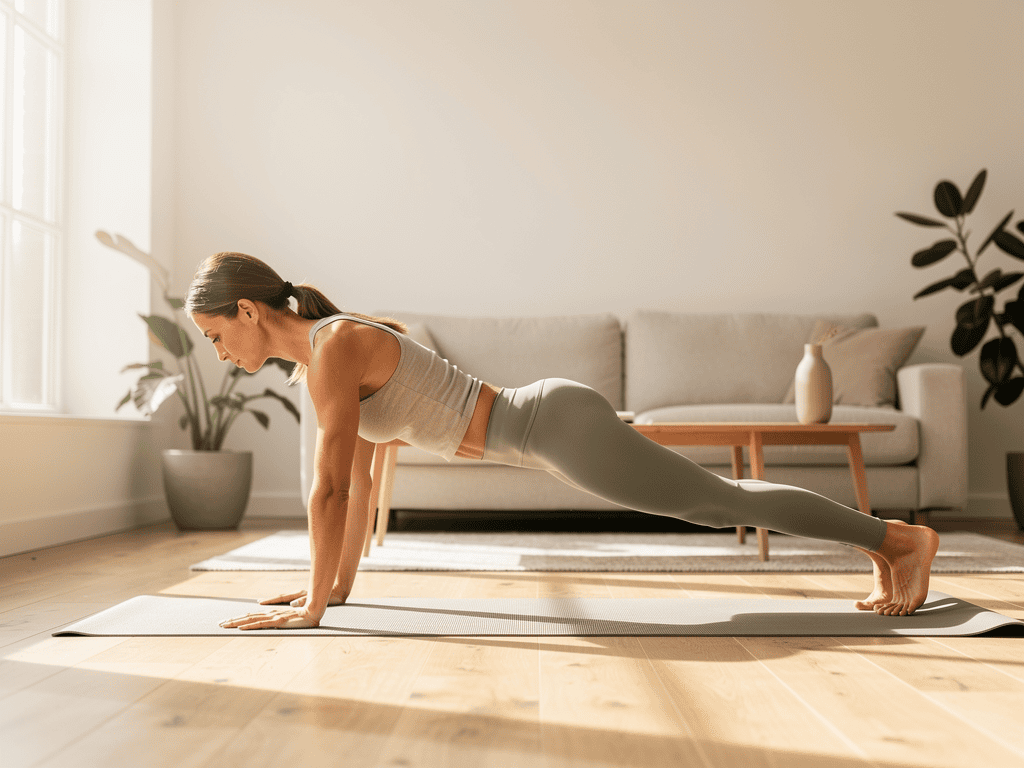
- Forearm plank. Elbows under your shoulders, body in one straight line from heels to the top of your head. Don’t sag in your lower back. Don’t hike your hips up. Keep it steady. If you’re shaking at the 30-second mark — that’s fine, it means the muscles are working. Goal — 2 minutes. Can’t do it — do intervals: 30 seconds plank, 10 seconds rest, repeat 4 times.
- Glute bridge. Lie on your back, knees bent, feet hip-width apart. Lift your pelvis up until your “knees–pelvis–shoulders” form a straight line. At the top, squeeze your glutes for 2 seconds. Lower slowly, don’t just drop. 15–20 reps. It’s not just the glutes working — the whole posterior “chain mechanism” that keeps you vertical kicks in.
- “Swimmer” — floor hyperextension. Lie on your stomach, arms extended forward. Simultaneously lift your right arm and left leg 10–15 cm off the floor. Hold for a second. Lower. Repeat with your left arm and right leg. That’s 1 rep. Do 12–15. This strengthens your spinal erectors — the muscles that hold you upright.
- Chest stretch in a doorway. Stand in a doorway. Bend your arms at 90 degrees, press your forearms against the door frame. Take a half-step forward. Feel the stretch across the front of your chest. These are your pectoral muscles — the main culprits behind “rounded” shoulders. Hold for 2 minutes. No jerky movements — this is a stretch, not a tug.
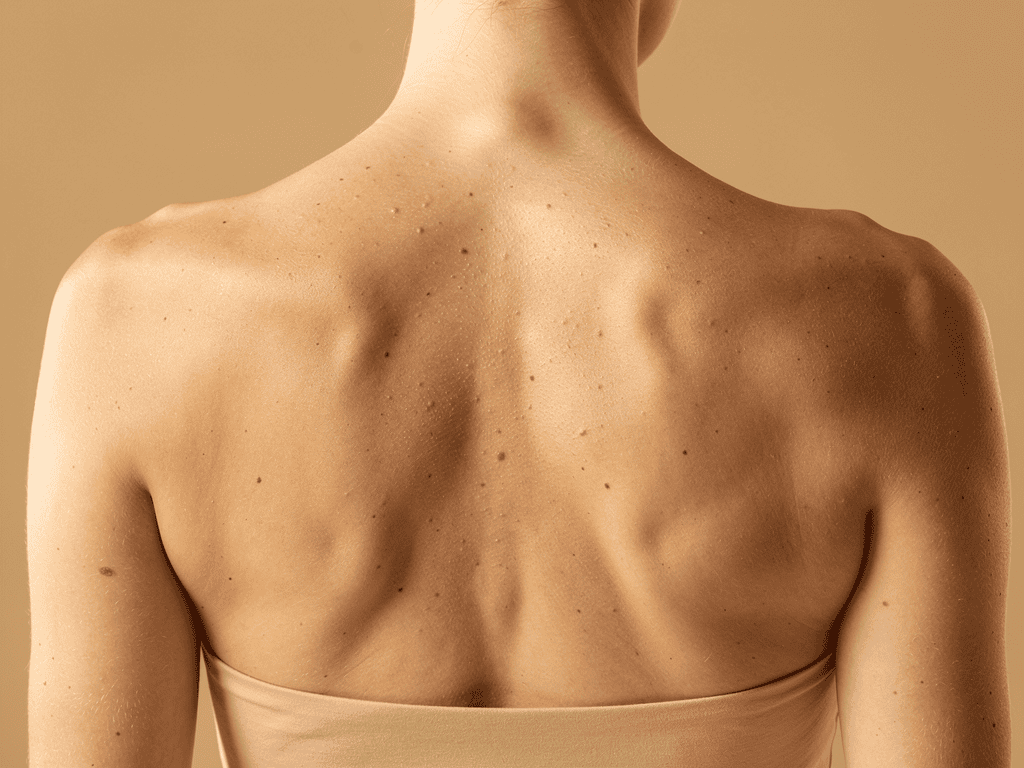
Important: No pain. Only tension and fatigue. If you feel sharp pain during an exercise — stop. It’s not “pushing through,” it’s a signal.
Do: 10 minutes in the morning, every day. After a week, add the same 5 exercises in the evening.
Don’t: Don’t try to “catch up” on weekends — an hour of planking on Saturday won’t replace 10 minutes daily.
How not to quit after three days: lifehacks for the lazy
You already know you quit everything after three days. Me too. So here’s a system — not “motivation,” but an actual mechanism:
1. Habit stacking. Attach the exercises to something you already do. Brushed your teeth — stood at the wall. Made coffee — plank by the couch. Not “I’ll find time,” but “right after X.”
2. Mat in plain sight. If you put the mat away in the closet — you’ve already lost. The mat lies on the bedroom floor. You step on it in the morning — signal: it’s time.
3. Timer, not counting. When you count reps — you cut corners. Set a timer for 10 minutes and flow through it. 10 minutes — and you’re free. Your brain needs a clear end, not “five more repssss.”
4. The 2-minute rule. On a day when you have “absolutely no energy” — do just the first exercise (the wall). 2 minutes. You’ve hit your quota. Often after the wall you’ll do the rest too — but the bar is set so low that “a valid excuse” disappears.
According to research in the European Journal of Social Psychology, habit formation takes anywhere from 18 to 254 days. But the median is 66 days. In two months, you won’t need “discipline” — your body will want to move on its own.
Checklist: what else works for posture (besides exercises)
Exercises are the foundation. But there are things that will boost the results with zero effort:
- Screen at eye level. Raise your laptop on a stand or a stack of books. The top edge of the screen should be at eyebrow level. Your neck will stop craning forward for 0 rubles.
- A chair with a lumbar roll. You don’t have to buy a “150-thousand-ruble ergonomic chair.” Roll a towel into a 10 cm cylinder and place it under your lower back. This preserves the natural arch.
- “Stand for 5 minutes every hour” mode. Set an alarm on your phone. Every hour, stand up for 5 minutes. Not “walk to the kitchen for a cookie” — actually stand. You can do it at the wall (see exercise 1).
- Sleeping on your side with a pillow between your knees. When you sleep on your side without support, your top thigh “rolls” forward — your pelvis twists. A pillow between your knees keeps your pelvis aligned all night.
- The right pillow under your head. Pillow height = the distance from your neck to your shoulder. For side sleeping, that’s 10–14 cm. For back sleeping — 6–10 cm. Lower — your head tilts back; higher — your neck bends. Both = pain by morning.

Frequently asked questions
Can you fix your posture as an adult?
Yes. Your spine doesn’t turn to stone at 25. Muscles adapt at any age. After 6–8 weeks of regular exercise, posture visibly improves — proven by millions of people and dozens of studies.
Do posture correctors (strap vests) work?
No. They hold your shoulders while you’re wearing them. Take it off — your muscles snap back to their usual position. Orthopedists call it a “crutch”: muscles atrophy because the straps do the work for them. Want results — train your muscles.
How long until the first results?
After 2 weeks of daily practice: coworkers will say “why are you standing so straight.” After a month: your back will stop aching by evening. After 3 months: your posture will change visually — in photos, in the mirror, in shop window reflections.
Does fixing your posture hurt?
The first 3–5 days — yes. Muscles that have been “asleep” for years wake up with a grudge. That’s normal — like after your first gym session. Sharp pain — not normal. A dull, pulling fatigue in your back muscles — fine.
Can I do these exercises with a bulging or herniated disc?
Only after consulting a doctor. Some exercises (plank, bridge) are usually allowed with bulging discs, but hyperextension (“swimmer”) may be off-limits. Don’t play “armchair orthopedist.”
Is 10 minutes a day enough for good posture?
To start — yes. It fires up the neuromuscular connection: your brain remembers where your back muscles are. For advanced results after 2–3 months, add a second 10-minute session in the evening and strength training twice a week.
Is it realistic to fix posture without fitness and weights?
Upper-back slouching — yes. These 5 bodyweight exercises address kyphosis (rounded shoulders). But scoliosis (lateral curvature) and pronounced hyperlordosis require a specialist. No way around it.
Verified: Recommendations are based on principles of biomechanics and rehabilitation medicine. This information is for educational purposes — if you have acute pain, see a doctor.