Why “just going to bed” stopped working
You get into bed at half past eleven, and your brain decides: what a great time to replay that awkward conversation from three years ago. Or tally up how much money went to food delivery this month. Or come up with a business plan that will seem ridiculous by morning.
You’re not alone in this. 40% of adults sleep less than seven hours. It’s not about “going to bed earlier.” The bed has turned into a boardroom where you hold internal debates while the screen shines blue light in your face.
The good news: sleep is not a lottery. It’s a skill. And it gets trained in the 20 minutes before your head hits the pillow.
In short:
– Your brain needs a shutdown ritual, just like a server needs a shutdown sequence
– Blue light and scrolling steal your melatonin faster than you can reach the end of the feed
– 20 minutes of the right actions replace 2 hours of lying with your eyes open
Audio version of the article: handy on the go, while cooking, or on a walk.
{“@context”:”https://schema.org”,”@type”:”AudioObject”,”name”:”Вечерний ритуал за 20 минут: как выключить голову и уснуть за 5″,”description”:”Голосовая версия статьи.”,”contentUrl”:”https://hervibehub.site/wp-content/uploads/2026/10/podcast-vechernij-ritual-za-20-minut.mp3″,”encodingFormat”:”audio/mpeg”,”duration”:”PT9M39S”}
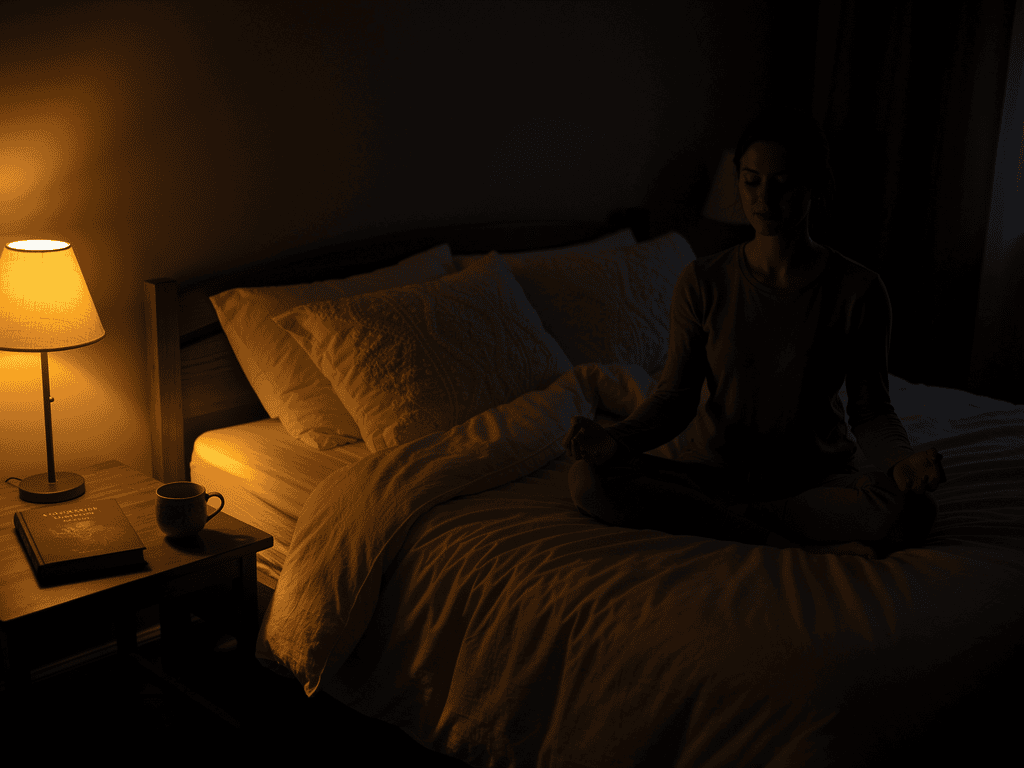
What actually happens in your brain when you can’t fall asleep
Falling asleep is not a switch. It’s a smooth transition from wakefulness to the first stage of sleep. At that moment, your brain is scanning the environment: is it safe here, is there any threat, is it time to solve problems.
And here’s the catch. If you spent the last hour before bed on your phone, your brain got a dose of blue light that told it: “the sun is still high, keep working.” If you were answering work messages until the last minute, your brain stayed in “firefighting” mode. If you got into bed and started replaying tomorrow’s tasks, your brain activated the prefrontal cortex — the part responsible for planning, not relaxing.
You’re literally giving your brain the command “sleep” and at the same time “think, solve, worry.” Guess which one it follows.
Do this: the last 20 minutes before bed are sacred time. No deadlines, no notifications, no planning. Only the ritual.
Don’t do this: don’t try to “quickly check email” before bed. One message drags a trail of thoughts behind it for 40 minutes.
The 20-minute ritual: step by step
Here’s a workflow that works. You don’t need to do everything perfectly from day one — introduce one step at a time. Within a week, your body will start yawning at the right moment on its own.
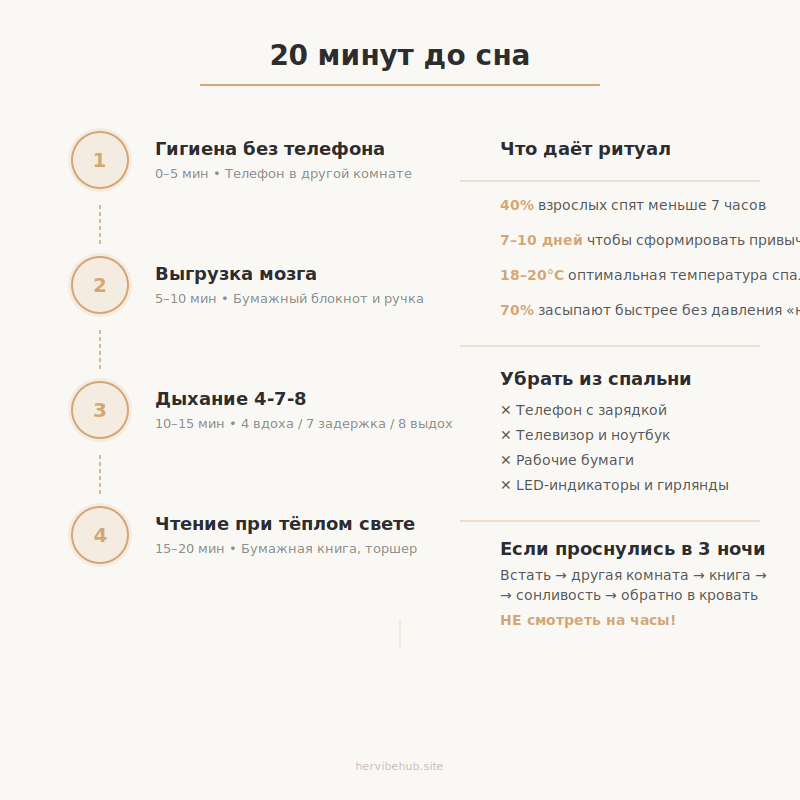
Minutes 0–5: Hygiene without the phone.
You brush your teeth, wash your face, apply moisturizer — everything as usual. The only difference: your phone stays in another room. It sounds like torture, but you’ll be surprised — within three days your hands will stop reaching for the screen automatically. Bonus: washing your face with cold water lowers your body temperature, which is a direct signal to the brain — time to sleep.
Minutes 5–10: Brain dump on paper.
Grab a notebook and a pen. Yes, a paper one. Write down everything spinning in your head: tomorrow’s to-do list, worries, questions, ideas. Don’t structure it, don’t judge it — just dump it out. It’s called a “brain dump,” and it really works: once thoughts are transferred to paper, the brain stops holding them in working memory. You’re literally telling it: “I wrote it down, we’ll sort it out in the morning, now — lights out.”
Minutes 10–15: 4-7-8 breathing.
Sit on the edge of the bed or lie down. Four seconds — inhale through the nose. Seven seconds — hold the breath. Eight seconds — slow exhale through the mouth. Repeat four times. This isn’t esoteric — it’s a technique from Dr. Andrew Weil at Harvard. The breath hold saturates the blood with carbon dioxide and slows the heart rate — the body shifts from “fight or flight” to “rest and digest.”
Minutes 15–20: Reading in dim light.
A paper book. Not a tablet, not a phone, not “just one chapter on my phone.” The text should be on paper, and the light should be warm — from a floor lamp or a night light. Fiction works better than non-fiction — stories pull your brain away from your real problems. And yes, if your eyes start closing on page three — close the book and sleep. That’s a win, not a loss.
Important: if you wake up in the middle of the night and can’t fall back asleep — repeat the breathing steps. Do NOT grab your phone “just to check the time.” Every screen activation restarts the sleep cycle from zero.
What to remove from your bedroom right now
Your bedroom is not a storage room, not an office, and not a movie theater. Every item in it either helps you sleep or gets in the way. Let’s get rid of what gets in the way.
Your phone and its charger. Buy a regular alarm clock for a few bucks. The phone charges in the hallway or the kitchen. Yes, you’ll miss that Instagram notification at three in the morning. That’s exactly the point. If you need to stay reachable for emergency calls, put your phone on “do not disturb” and whitelist two or three contacts.
TV and laptop. The bedroom is for sleep and sex. That’s it. A screen on the wall makes the brain associate the bed with activity. After two weeks without a screen in the bedroom, you’ll notice: you lie down — and you’re out in five minutes. That’s a conditioned reflex you broke with years of binge-watching under the blanket.
Work papers and laptop. If there’s a report on your nightstand that’s due Friday, your brain sees it out of the corner of its eye and doesn’t relax. Even if you’re not consciously thinking about it. Move everything work-related to another room, or at least into a closet.
Bright indicator lights and string lights. Any LED on a router, charger, or humidifier turns into a floodlight in total darkness. Cover them with black electrical tape. String lights — turn them off, even if they’re cute.
Checklist: inspect your bedroom in 2 minutes
☐ No phone in the room, or it's on "do not disturb"
☐ All blue/green indicator lights are covered or removed
☐ Curtains block light (test: turn off the lights during the day — it should be dark)
☐ Temperature 18–20°C (this is the optimal range for sleep)
☐ No work-related items in sight from the bed
Replacing scrolling: three ways to switch off your brain without a phone
You know scrolling before bed is garbage. But your hand still reaches for it. Because the brain needs something to occupy those last minutes before shutting down. Just lying there waiting for sleep is torture for an anxious brain. It needs a replacement. Here are three options that work better than the feed.
1. Audiobook or podcast on a timer. Set it for 15 minutes, put the phone far away, and play something calm through a low-volume speaker. The narrator’s voice gives the brain a focal point — it stops wandering through your worries. The rule: nothing gripping. The history of Rome — yes. A thriller about a serial killer — no.
2. Progressive muscle relaxation. Lying in bed, tense and relax muscle groups one by one: feet → calves → thighs → stomach → chest → arms → face. Five seconds of tension and ten seconds of release for each. The result — your body feels like it’s made of lead and sinking into the mattress. This technique comes from the US military program — the full cycle takes 120 seconds.
3. The “do nothing with your eyes open” method. It sounds dumb, and it works without fail. Lie down in the dark and tell yourself: I’m not going to sleep. I’ll just lie here and rest. Paradoxical intention removes the pressure of “I must fall asleep” — the very thing keeping you tense. In 70% of cases, you’ll be out within the first 15 minutes — precisely because you stopped trying.

Verified: all techniques are based on clinical sleep research. The 4-7-8 breathing technique — Dr. Andrew Weil, Harvard. Progressive relaxation — Edmund Jacobson, 1929, confirmed by dozens of studies up to 2025. Paradoxical intention — Viktor Frankl, logotherapy.
Frequently asked questions
What should I do if I wake up at 3 a.m. and can’t fall back asleep?
Get up. Go to another room, turn on dim light, read a paper book for 15 minutes. Go back to bed when you feel sleepy. If you lie there angry at your insomnia, the bed starts to be associated with frustration, and the problem becomes entrenched.
How long does it take for the ritual to start working?
The first effect comes on the very first night (4-7-8 breathing slows your pulse immediately). A lasting habit forms in 7–10 days. The key is to do the ritual at the same time every day, even on weekends. The brain loves predictability.
Can I replace a paper book with a Kindle?
Yes, if the Kindle has no backlight or has a warm backlight at minimum. E-ink screens don’t emit the blue spectrum, unlike phones and tablets. But a Kindle with a cold backlight is just as much an enemy of sleep as a phone.
Should I take melatonin supplements?
Melatonin is produced by your body on its own. Supplements make sense for jet lag or time zone changes — at a dose of 0.5–1 mg, not 5 mg like in pharmacies. Before taking it, get your melatonin and cortisol levels tested. The main thing: a pill doesn’t replace the ritual. It won’t shut off an anxious brain that keeps solving problems.
What if the ritual didn’t help and I’m still lying awake?
Don’t panic. One bad night won’t ruin your health — anxiety about a bad night will. If insomnia lasts more than three months at least three times a week, book an appointment with a sleep specialist. Cognitive behavioral therapy for insomnia (CBT-I) delivers 70–80% results — higher than any pills. You can find a specialist through the Russian Society of Sleep Medicine.