How to Stop Comparing Yourself to Others: A Guide for the Exhausted
You opened Instagram for a couple of minutes — and now you know: Lenka bought an apartment in Moscow, Mashka dropped 12 kg, your former classmate launched her third business and had her second baby on the side. And there you are, sitting in pajamas with a mug of cooling tea, feeling like a complete failure. Stop. You haven’t failed. Your brain just got stuck in “compare everything” mode. Almost 300 hours a year you spend methodically convincing yourself: “something’s wrong with me.” Let’s figure out how to switch off that inner monologue — no meditation, no mirror affirmations, no “just love yourself” advice.
In short:
– The comparison habit lives in your brain at the neural pathway level — like smoking or nail biting
– Instagram and TikTok are programmed to show you other people’s success, not reality. It’s business
– 5 specific techniques break the habit within a week. First results — by day three
Audio version of the article: perfect for commuting, cooking, or walking.
{“@context”:”https://schema.org”,”@type”:”AudioObject”,”name”:”How to Stop Comparing Yourself to Others: A Guide for the Exhausted”,”description”:”Audio version of the article.”,”contentUrl”:”https://hervibehub.site/wp-content/uploads/2026/10/podcast-kak-perestat-sravnivat-sebya.mp3″,”encodingFormat”:”audio/mpeg”,”duration”:”PT9M51S”}
Why You Compare in the First Place: Instagram, Mom, and the Voice in Your Head
The comparison mechanism is built into us from the cradle. In 1954, psychologist Leon Festinger described the “social comparison theory”: we need to measure ourselves against others to understand our coordinates. Back then, you compared yourself to three friends in the yard. Now — to three million filtered lives in your feed.
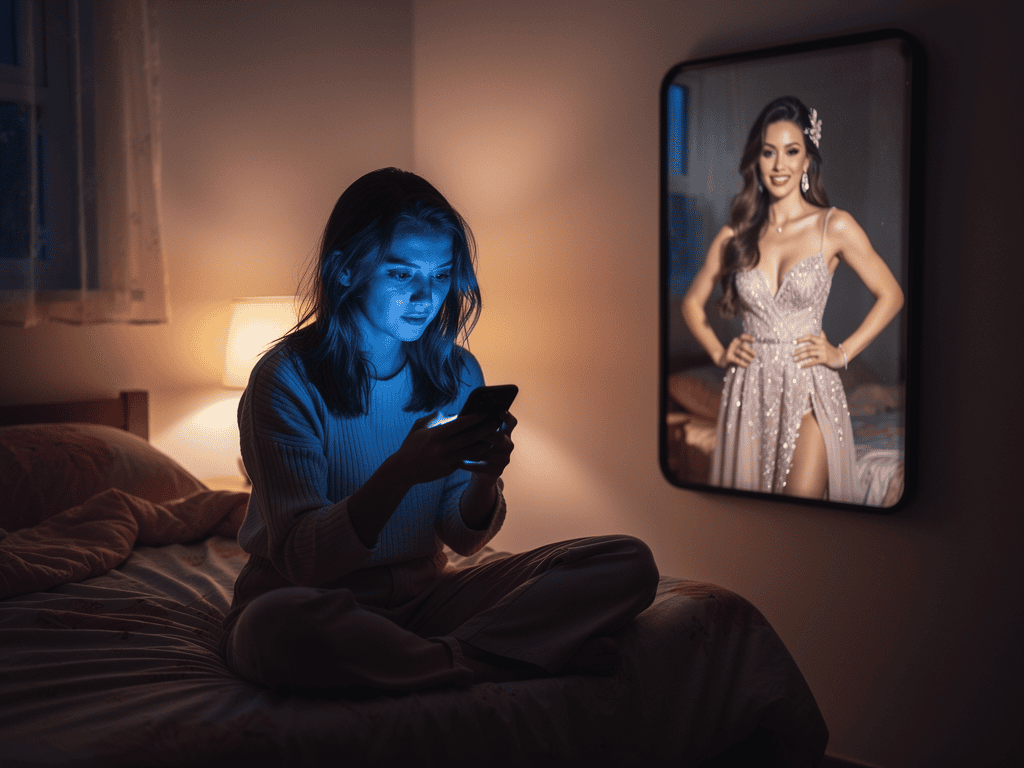
Instagram is not a window into reality. It’s a storefront. You see the best shot out of a hundred attempts, edited in Facetune, shot under a ring light that cost 15 grand. That’s not Lenka’s life. That’s her promotional brochure. And you place it next to your unpolished Wednesday and conclude: “I lost.”
A special “hello” goes to the parental voice in your head. “Look at Aunt Valya’s daughter — already married, and you…” — and that phrase, heard at 14, keeps working at 30. Your inner critic uses the same words your mom once did. Except now it compares you not to Aunt Valya’s daughter, but to a millionaire blogger from Dubai.
The takeaway: You’re comparing your behind-the-scenes to someone else’s storefront. It’s like putting your passport photo next to a Vogue cover — and being surprised the second one looks better.
What Comparison Actually Does to Your Brain
Social comparison is not a harmless habit. When you scroll your feed and see someone else’s “success,” the amygdala — the anxiety center in your brain — activates the same way it would during a real threat. You’re not just “upset.” Your body has launched a stress response: cortisol spiked, heart rate went up. And that happens 40–50 times a day.
Research from the American Psychological Association links passive scrolling to increased depressive symptoms in women aged 18–35. Not because you’re “weak.” Because your brain wasn’t designed for this volume of social stimuli. It could handle 50 people in a tribe. It got 5,000 Facebook friends — and it broke.
The worst part: algorithms deliberately poke at your sore spots. Lingered on a photo of a slim woman? For the next two weeks, your feed will show only fitness girls and “lose 5 kg” ads. TikTok learns your triggers in 40 minutes and starts serving them in measured doses — just enough to keep you from putting the phone down, but already enough to make you feel not good enough. This isn’t a conspiracy. It’s an advertising model. And in it, you are the product.
The numbers: The average woman checks her phone 96 times a day. Every third glance ends in micro-comparison. That’s ~30 hits to your self-esteem. Daily.
5 Techniques to Shut Down the Endless Scrolling
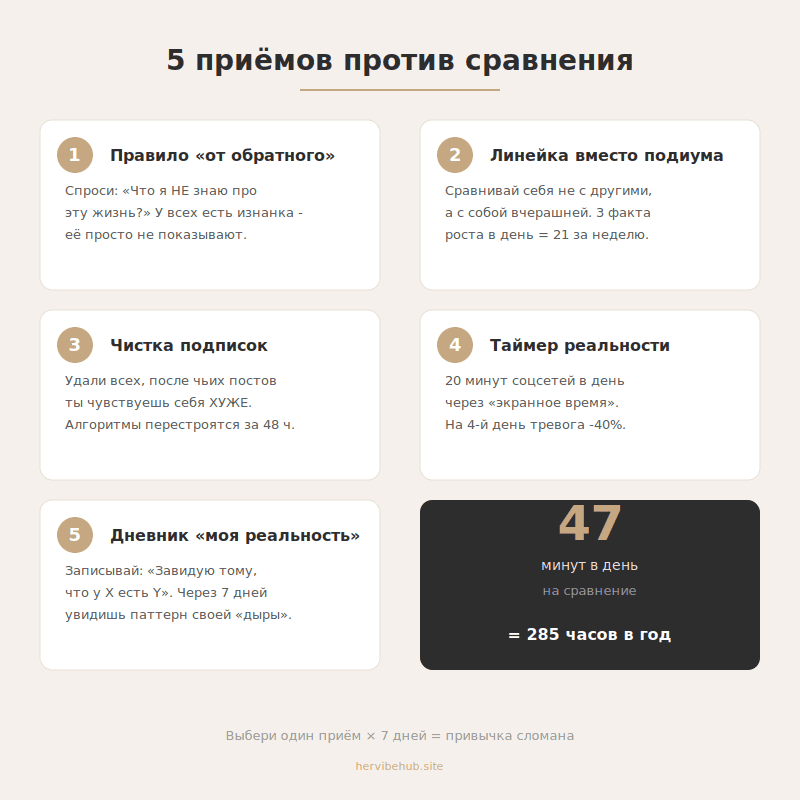
- The “reverse” rule. When you catch yourself staring at someone else’s success, ask: “What do I NOT know about this life?” Behind the postcard — debts, sleepless nights, a toxic partner, a loan for that very iPhone. Everyone has a behind-the-scenes — they just don’t all show it. Do this 10 times in a row — the habit of “filling in the behind-the-scenes” locks in as automatic.
- A ruler instead of a runway. Compare yourself not to others, but to yesterday’s you. Write down three things you did better today: “got up 20 minutes earlier,” “didn’t snap at my kid.” After a week — 21 real pieces of evidence of growth. Your brain needs facts — give them to it.
- A 10-minute subscription purge. Open your following list. Unfollow everyone whose posts make you feel WORSE. A blogger from the Maldives whose course you’ll never buy? Blocked. A friend whose life seems perfect? Unfollowed. Algorithms will readjust within 48 hours.
- A reality timer. Social media limit — 20 minutes a day. Not through willpower, but physically: “screen time” in settings, give the password to a friend. The first two days — withdrawal. By day three — an hour of free life. By day four — anxiety down 30–40%. Less social media = fewer reasons to compare.
- A “my reality” journal. Every time you catch yourself comparing — write in your notes: “I envy that [имя] has [что].” Don’t judge. Just record. After 5–7 days, reread it — you’ll see the pattern. Maybe you only compare yourself to people who earn more. That’s not about them. That’s about your hole. Once you see the hole — you can fill it.
Important: Pick one technique and do it for 7 days straight. One. Not all five at once. A habit breaks through consistency, not first-week heroics.
What Happens When You Stop
The first thing you’ll notice is silence. The inner voice that for years commented on other people’s wins with “and where are you going?” will start to quiet down. By day three, you’ll open Instagram — and you’ll feel… nothing. No envy, no shame, no urge to change everything immediately. You just scroll and forget within a minute.
Second — time will appear. Those 47 minutes a day spent on self-flagellation will turn into 47 minutes of life. Someone will start reading, someone will finally sleep properly, someone will call an old friend for the first time in a year just to chat — not to compare degrees and salaries.
Third — you’ll discover that the people around you aren’t actually that happy. Lenka, who bought the apartment, is crying over her mortgage. Mashka, who dropped 12 kg, is on antidepressants. The blogger from Dubai films her “perfect breakfast” in a rented studio with cockroaches just out of frame. No one lives the life they show. Absolutely no one.
When you truly understand this — not just in your head, but at the level of habit — you stop being a spectator in someone else’s movie and become the director of your own. With awkward takes, bloopers, imperfect lighting. But alive. Real. Yours.

Verified: Social media’s impact on self-esteem — American Psychological Association research (APA, 2023). Screen time figures — DataReportal Digital 2026 report. Practical techniques — cognitive behavioral therapy (CBT), adapted for self-guided work. Author: HerVibeHub team.
Frequently Asked Questions
How long does it take to stop comparing yourself?
First results come on day 3–4 with daily practice of one exercise. Full consolidation takes 21–28 days. The key is not to quit in the first week, when your brain starts “rolling back” to the old pattern.
What if I compare myself to colleagues at work?
Shift your focus from “she’s better at this” to “what can I learn in 15 minutes?” A concrete question: “How did you do that? Show me one trick.” Envy turns into learning — and disappears.
Will deleting social media entirely help?
No. You’ll leave Instagram — and start comparing yourself to neighbors in the elevator and relatives at dinners. The problem isn’t social media. The problem is the habit. Work on it — and social media becomes a tool, not a weapon.
Can I compare myself to others “positively” — as motivation?
Yes, if the comparison ends with action within 24 hours. Saw a fitness blogger’s great abs? Book a trial workout today. Just “got inspired and forgot” — same hole, just with a bow on top.
What if my partner compares me to others?
Red flag. A direct conversation: “I don’t like it when you compare me to someone else. Speak to me directly, without examples of other women.” If that doesn’t help — find someone who won’t measure you with someone else’s ruler.
How do I stop comparing my salary to other people’s income?
Change the ruler. Compare “my income today vs my income a year ago.” If there’s growth — you’re fine. If there’s no growth — that’s a signal: time to ask for a raise or change jobs. Action, not self-digging.