Seasonal Blues: How to Tell It Apart from Depression and Pull Yourself Out in 7 Steps
Seasonal blues is a dip in mood and energy that arrives with shorter daylight hours and fades by spring. The working formula: 30 minutes of bright light in the morning, 20–30 minutes of walking midday, and waking up at the same time every day. If after two weeks you don’t feel better, your sleep stretches to 10 hours, and you’ve lost energy for everything — that’s no longer just the blues, that’s a reason to see a doctor.
In short:
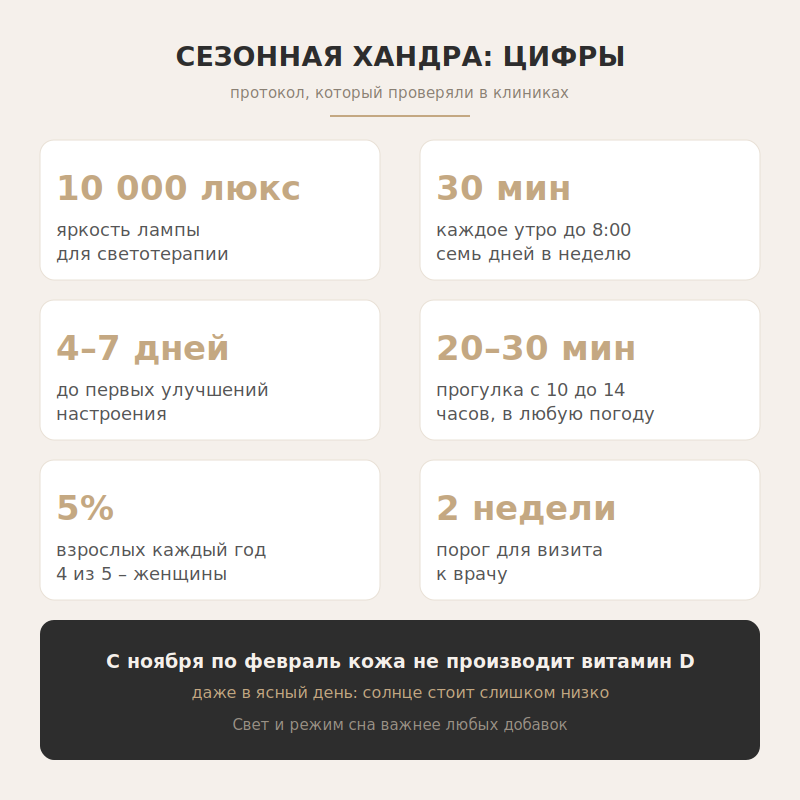
– 10,000 lux for 30 minutes every morning — the standard for light therapy, validated in clinical studies
– About 5% of adults experience seasonal depression each year, four out of five are women
– From November to February in mid-latitude regions, the skin produces no vitamin D even on a clear day
Why November Hits Hard: Light, Melatonin, and Serotonin
In Moscow, December 1st has about 7 hours of daylight; June 22nd has about 17.5. That’s a 10.5-hour difference, and the body doesn’t adjust in a single day.
Light hits the retina and sends a signal to the hypothalamus — the part of the brain that keeps the internal clock. Two reactions follow. First: morning light suppresses melatonin, the sleep hormone. In winter there’s no light, melatonin doesn’t drop, and you wake up feeling like “the body is still asleep.” Second: light supports serotonin production, and there’s less of it in winter — hence the cravings for sweets and carbs, because fast carbohydrates boost mood for a couple of hours.
It’s not the intensity of emotions that breaks down — it’s their daily schedule. Thoughts have nothing to do with it — light levels are to blame.
Do this: catch light in the first 60 minutes after waking — open the curtains, step onto the balcony, go outside, or use a lamp.
Don’t do this: don’t sit in the dark with your phone in the morning. A screen gives 200–300 lux, but you need thousands to reset melatonin.
Blues or Depression: A Comparison Table
The line is drawn by duration and depth. Blues is a state; depression is a diagnosis made by a doctor. Below are guidelines for self-checking, not a replacement for seeing a specialist.
| Sign | Blues | Seasonal depression |
|---|---|---|
| Duration | 2–5 days, comes in waves | 2 weeks or more without a break |
| Sleep | Want to sleep a bit more | 10–12 hours and still exhausted |
| Appetite | Craving sweets in the evening | Eating more than usual all day, gaining 3–5 kg per month |
| Interest | Lazy, but favorite activities still engage you | Nothing brings joy, including things that used to sustain you |
| Work | Getting things done, but slower | Can’t focus on simple tasks |
| What helps | Light, walking, consistent sleep | Light therapy + medical help |
Heavy thoughts about your own worthlessness or about not wanting to exist — that’s a red flag: stop talking about routines and start seeing a psychiatrist.
Do this: start a note and track sleep, mood, and outdoor time on a scale of 1 to 10 — after a week you’ll see the trend.
Don’t do this: don’t self-diagnose based on an article and don’t prescribe antidepressants from forum advice.
A 6-Question Test: When to See a Doctor
Two or more “yes” answers — go to a GP or psychiatrist, not to the pharmacy for vitamins.
- Low mood persists for more than 14 days with almost no breaks.
- You sleep 9–12 hours and still don’t feel rested.
- You’ve lost interest in things you used to enjoy.
- You can’t work: simple tasks take three times longer.
- Your appetite has increased, and you’ve gained 3 kg or more in a month.
- You have thoughts that your loved ones would be better off without you.
For self-assessment, there’s the PHQ-9 questionnaire: 9 questions scored from 0 to 3. A total of 10 or higher indicates clinically significant symptoms; 15 or higher indicates moderate severity. This is a screening tool, not a diagnosis.
Light Therapy: The 10,000 Lux Protocol Without Mistakes
This method has been studied more than anything else in this field: US national guidelines on light therapy describe it as a first-line treatment for seasonal affective disorder. The standard: a 10,000 lux device, 30-minute sessions, every morning, seven days a week, ideally before 8 AM. Improvement usually comes on day 4–7, with full effect after 2 weeks.
- What to buy. A lamp labeled 10,000 lux with a UV filter, color temperature 4000–6500 K. In Russia, these cost 4,000–12,000 ₽.
- Where to place it. On a desk 40–60 cm from your face, slightly to the side. Light should reach your eyes; you don’t need to stare directly into the device.
- How long. 30 minutes. If you get a headache or irritability, cut it to 15 minutes and add 5 minutes per day.
- When. Within the first 2 hours after waking. An evening session shifts your internal clock forward and disrupts falling asleep.
A 2000–3000 lux lamp sold as a “mood lamp” doesn’t replace the protocol: at that low output, the session stretches to 1–2 hours. Tanning beds are also off the mark — they emit UV, not visible light.
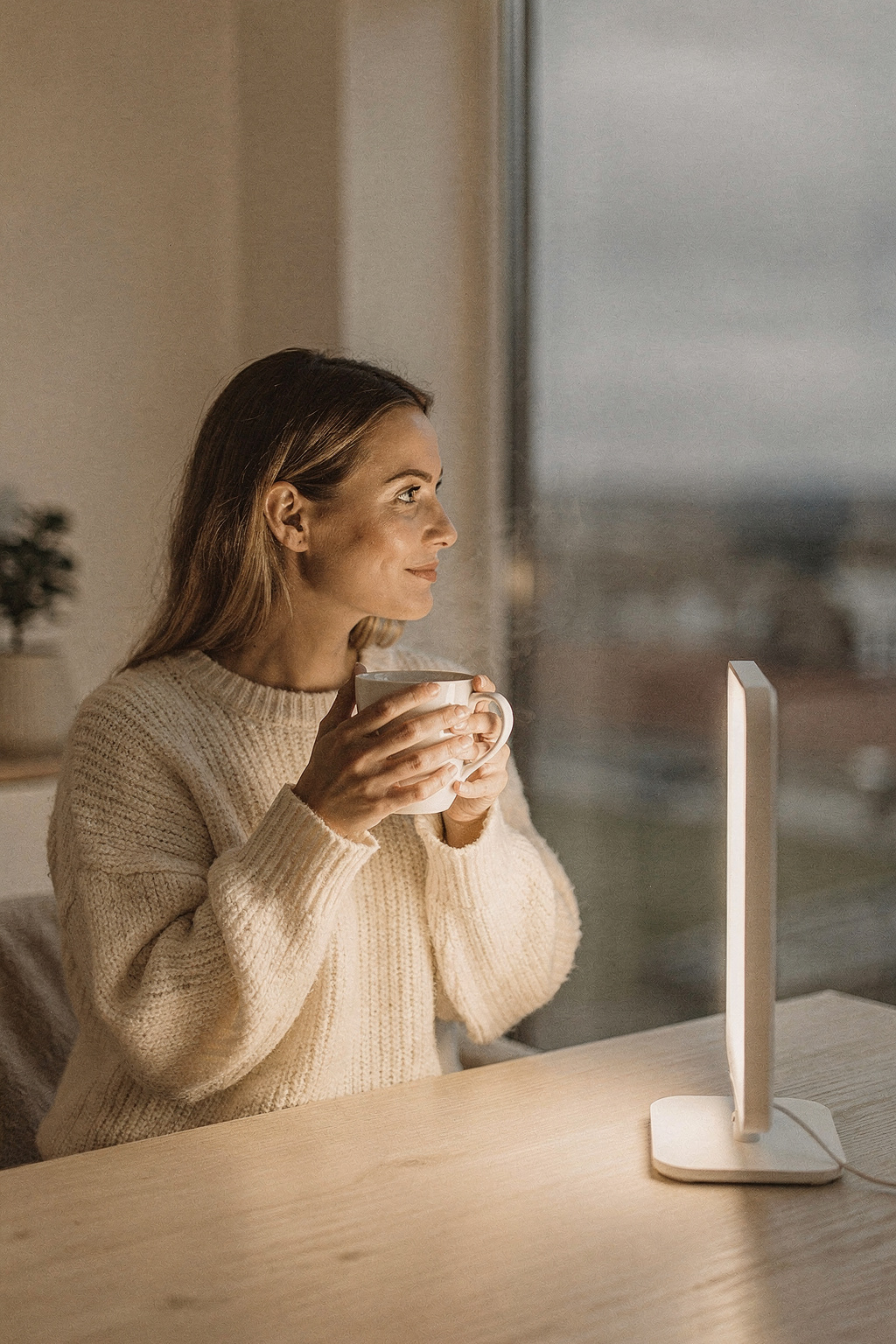
Do this: build the lamp into your morning ritual — light while you drink tea and check email. 30 minutes passes on its own.
Don’t do this: don’t buy a device without a UV filter and don’t sit under it for 2 hours “to speed things up.”
Outdoor Light: How Many Minutes and When to Walk
An overcast day outside gives 1000–5000 lux, while a bright room gives 300–500. So half an hour outdoors covers eight hours in the office.
The ideal window is from 10 AM to 2 PM: that’s when light is brightest, and in mid-latitude regions UV is nearly absent from November to February. The skin doesn’t produce vitamin D during these months, even under a clear sky — the sun sits too low. Meaning: walk for light and movement; get vitamin D from food and supplements.
About supplements: get a 25(OH)D test; if you’re deficient, a doctor will prescribe the dose. A typical maintenance dose is 800–1000 IU per day; anything above 4000 IU is prescription-only.
Do this: go out for 20–30 minutes before noon, without headphones and a podcast “for later” — your brain needs light, not information.
Don’t do this: don’t replace a walk with standing by a window. Glass filters out UV and part of the spectrum, and light levels near a window drop dramatically.
7 Steps for the Week: A Day-by-Day Plan
- Monday. Baseline. Write down when you woke up, how long you were outside, your sleep and mood on a scale of 1–10. This is your starting point.
- Tuesday. Wake-up routine. Set your alarm for the same time and get up at that time for seven days, weekends included. A stable wake-up time matters more than an early bedtime.
- Wednesday. Morning light. 30 minutes of bright light within the first two hours of waking: a lamp, the balcony, or outside.
- Thursday. Lunchtime walk. 20–30 minutes between 10 AM and 2 PM. Even in the rain: clouds lower light levels, but not down to indoor levels.
- Friday. Caffeine before 2 PM. Caffeine’s half-life is 5–6 hours; by 8 PM a quarter of the dose remains, keeping your sleep shallow.
- Saturday. Screens off 2 hours before bed. A bright screen in bed delays falling asleep by 30–60 minutes. Replace it with a paper book and warm light.
- Sunday. Review. Compare your notes to Monday. If sleep and mood haven’t shifted by a point — that’s a reason for a doctor’s appointment, not a second week of self-treatment.
What Doesn’t Work: 5 Pieces of Internet Advice
- “Just think positive.” Thoughts don’t regulate melatonin. Light and routine first, then mindset.
- “Eat more citrus.” Vitamin C isn’t involved in serotonin synthesis. An orange doesn’t hurt, but it doesn’t cure the blues.
- “Go to a tanning salon.” UV gives you a tan and skin risk, not 10,000 lux of visible light.
- “Take vitamin D by the handful.” Without a blood test, the dose is a lottery. Above 4000 IU without monitoring is a risk to your kidneys.
- “Just rest at home.” Home in winter is the darkest place on your schedule. Resting within four walls usually makes things worse.

Fact-checked: the light therapy protocol (10,000 lux, 30 minutes, morning) and seasonal affective disorder prevalence data — based on publications from the US National Institute of Mental Health (NIMH) and Mayo Clinic. Lamp prices — from Russian marketplaces, November 2026. Author: HerVibeHub editorial team.
Frequently Asked Questions
How many days does light therapy take to work?
First changes appear on day 4–7; lasting effect comes after 2 weeks of daily sessions. Skipping weekdays resets the effect.
Can I replace the lamp with a regular desk lamp?
No. A desk lamp gives 300–500 lux; the protocol requires 10,000 — a twenty-fold difference. Instead of buying one, it’s easier to add a midday walk.
Does vitamin D help with the blues?
Only with a confirmed deficiency. If your 25(OH)D level is normal, supplements won’t change your mood — light and sleep routine work more reliably.
Why do I want to sleep 10 hours in winter?
Melatonin isn’t suppressed in the morning due to lack of light, and your internal clock shifts. Bright light within the first two hours of waking and a fixed wake-up time help.
Is it dangerous to sit under a 10,000 lux lamp?
With a UV filter — no. Restrictions: glaucoma, retinal conditions, photosensitizing medications, bipolar disorder. In these cases, consult a doctor before the first session.
When does the blues turn into depression?
When symptoms persist for 2 weeks or more and interfere with work. Then it’s time to see a psychiatrist: light therapy stays in the plan, but alongside treatment.
Does November really knock you out, or are you one of those who’s “just tired”? And what have you already tried: a lamp, walks, vitamin D — or are you still just waiting for spring? Tell us in the comments — let’s gather real winter survival stats.
Read next: office syndrome: neck, back, and eyes in 15 minutes and tired eyes from screens: 6 exercises.