Office Syndrome: Why Your Neck, Back, and Eyes Hurt by Evening – and What to Do in 15 Minutes
If by 6:00 PM your neck feels like wood, there’s a dull ache between your shoulder blades, and your eyes feel like they’re full of sand – that’s office syndrome. It comes from 6–8 hours in one position: your neck and back muscles hold your head up without movement, and your eyes never change focus. Fifteen minutes a day stops it: 6 movements, the 30/3 rule, and setting up your workspace for your height.
In short:
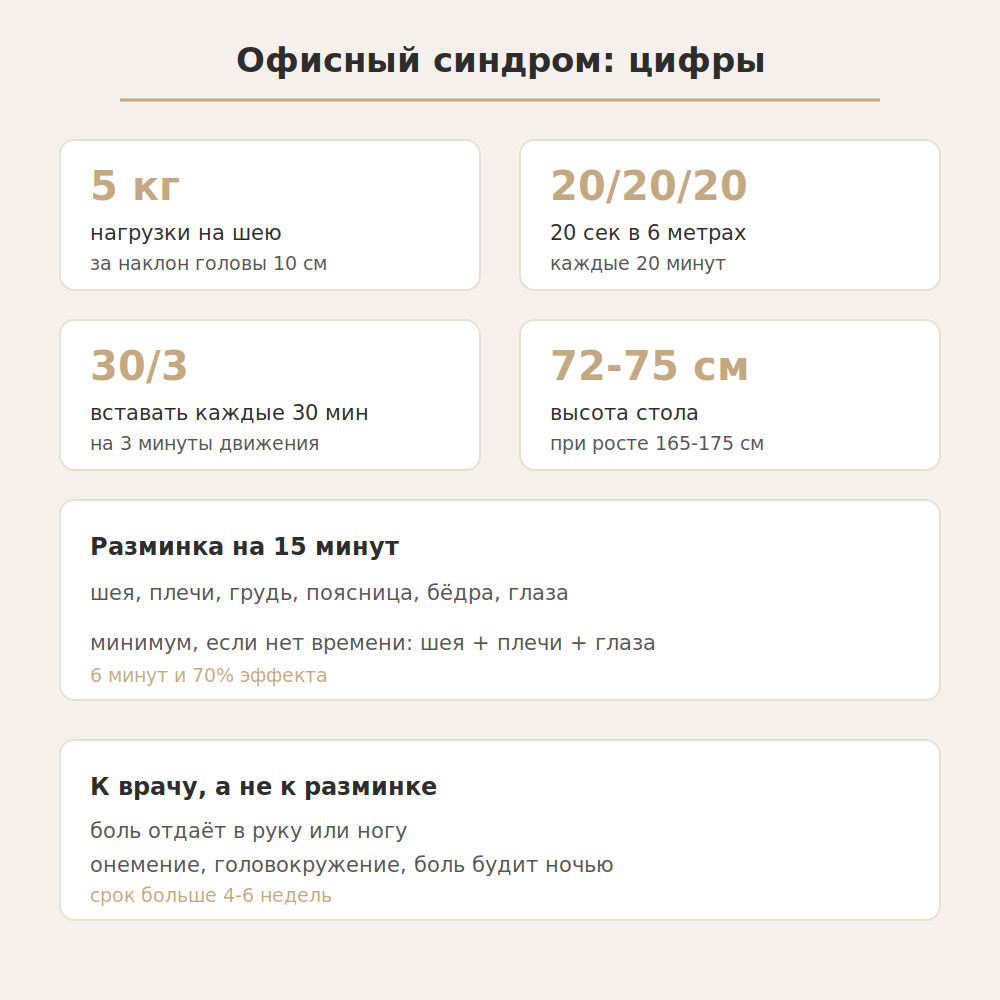
– Top of the monitor at eye level: every 10 cm of head tilt adds 5 kg of load on your neck
– The 30/3 rule: every 30 minutes, get up for 3 minutes – otherwise your muscles get no blood flow
– The 20/20/20 rule: every 20 minutes, look at something 6 meters away for 20 seconds
– Desk height 72–75 cm for heights 165–175 cm; chair adjusted so your elbows are at 90 degrees
Audio version of the article: perfect for commuting, cooking, or walking.
{“@context”:”https://schema.org”,”@type”:”AudioObject”,”name”:”Office Syndrome: Why Your Neck, Back, and Eyes Hurt by Evening – and What to Do in 15 Minutes”,”description”:”Audio version of the article.”,”contentUrl”:”https://hervibehub.site/wp-content/uploads/2026/10/podcast-ofisnyj-sindrom-sheya-spina-glaza.mp3″,”encodingFormat”:”audio/mpeg”,”duration”:”PT10M8S”}

What Is Office Syndrome and Why It’s Not About Laziness
Office syndrome is a set of symptoms from prolonged sitting in a static position: pain in the neck, shoulders, and lower back, heaviness in the eyes, numbness in the legs, and headaches by evening. Doctors call it “prolonged static posture syndrome.”
The mechanics are simple. Muscles need to contract and relax to pump blood. In a static position, they work without pauses: the neck and lower back muscles hold the weight of your head and torso for hours. Blood flow drops, metabolic waste builds up in the muscles, and a dull ache appears.
The eyes suffer separately. A person normally blinks 15–20 times per minute, but in front of a screen – only 5–7 times. The tear film dries out faster than it can replenish, and that sandy, burning feeling kicks in.
And third: when you sit, you barely engage the large muscles in your legs. According to WHO data, adults need 150–300 minutes of moderate activity per week, and 8 hours of sitting doesn’t replace that.
Do this: treat neck pain as a signal, not as a normal end-of-day state.
Don’t do this: don’t wait until the weekend. After 5 days of static posture, muscles lose elasticity, and Saturday will feel worse, not better.
How to Know If You Have Office Syndrome: A 6-Sign Checklist
Check yourself against this list. If 3 or more match – it’s not a one-off bout of fatigue; it’s a pattern that repeats every week.
- Your neck doesn’t turn fully. To look behind you, you turn your torso, not your head. The norm is an 80-degree turn to each side without pain.
- A “stake” between your shoulder blades. An aching spot that loosens up but comes back within an hour.
- Your lower back aches by evening. In the morning everything is fine; by 5:00 PM you just want to lie down.
- Your eyes are dry and red. By evening it’s hard to look into the distance; the picture goes blurry.
- Your legs go numb and your palms tingle. From compressed blood vessels behind the knees and in the carpal tunnel.
- A headache pressing on the back of your head. Not your temples – specifically the base of the skull, caused by tight neck muscles.
Do this: write down which of the 6 points are yours, then recheck after a week of stretching – that’s how you see results.
Don’t do this: don’t blame neck pain on age. Office syndrome is more common in 30-year-olds than in 50-year-olds doing physical work.
How to Set Up Your Workspace in 10 Minutes: 5 Steps with Numbers
Half the problem is solved by geometry. When your monitor and chair are positioned correctly, your muscles hold your head without effort, and pain doesn’t build up.
- Monitor: top of the screen at eye level. Tilting your head 10 cm forward adds about 5 kg of load to your cervical spine. Distance to the screen – an arm’s length, 50–70 cm.
- Desk: 72–75 cm for heights 165–175 cm. A simple rule: sitting with your elbows at 90 degrees, forearms on the desk, shoulders not raised.
- Chair: backrest supporting your lower back. The lumbar support should press into the curve of your lower back, not the middle of your spine. Feet fully flat on the floor, not on your toes.
- Keyboard and mouse close to your body. If you have to reach, your shoulder rolls forward and your neck tightens up within 20 minutes.
- Lighting: screen not facing a window. Position the monitor sideways or with your back to the window, not facing it. Glare on the screen makes you lean in.
30-second check:
Elbows at 90 degrees        -> desk is the right height
Top of monitor at eye level -> neck is not tilted
Feet flat on the floor      -> lower back is unloaded
Screen 50–70 cm away        -> eyes are not overstrained
Do this: raise your laptop on a stand and connect a separate keyboard. A laptop on the desk always means either your neck or your wrists suffer.
Don’t do this: don’t work for an hour lying down with a laptop on your knees. That’s the worst position for your neck of all.
15-Minute Micro-Stretch: 6 Movements with Reps
This isn’t a workout; it’s an unlock. The goal is to restore blood flow to tight areas, not to tire yourself out. You can do it at the office – no mat, no changing clothes.
- Neck. Slow head turns right and left as far as they go, 10 times each side. No jerking and no circular rotations.
- Shoulders. Shoulder circles backward: 15 forward, 15 back. Squeeze your shoulder blades together as if holding a pencil between them.
- Chest. Clasp your hands behind your back, push your straight arms back, and hold for 20 seconds. You should feel the muscles between your shoulder blades working, not your lower back.
- Lower back. Seated: 10 forward bends with a straight back, reaching your hands toward your feet. Don’t round your back – that matters.
- Hips. Standing: pull one knee to your chest, hold 15 seconds, then switch. This releases tightness in the front of the thigh.
- Eyes. Look at a distant object 6 meters away for 20 seconds, then at your finger in front of your nose for 20 seconds. 5 rounds.
The whole routine takes 12–15 minutes. If you’re really short on time, just do the neck, shoulders, and eyes: that’s 6 minutes and 70% of the benefit.
Do this: put the stretch break in your calendar for 3:00 PM – neck pain usually peaks around then.
Don’t do this: don’t stretch sharply through pain. In the cervical spine, jerky movements can end worse than sitting.
The 30/3 and 20/20/20 Rules: What to Do During the Day
A morning and evening stretch won’t save you if you sit without breaks for 4 hours in between. You need short pauses throughout the day – they take no time and don’t interfere with work.
- The 30/3 rule. Every 30 minutes, stand up for 3 minutes. Walk to the water cooler, stretch, make tea. Over an 8-hour day, that’s 16 short breaks – 48 minutes of movement total.
- The 20/20/20 rule. Every 20 minutes, look at something 6 meters away for 20 seconds. This lets your eye muscles shift focus and restores the tear film.
- The two-hours-on-your-feet rule. If you work standing for half the day, the load on your lower back drops by about 30%. Just raise your laptop onto a tall cabinet.
Do this: set an alarm with sound. Without a reminder, you’ll skip the pause by the third hour.
Don’t do this: don’t replace pauses with coffee. Caffeine doesn’t loosen muscles, and before bed it also interferes with recovery.
Let’s Compare: What Actually Helps and What Wastes Money
| Remedy | What it actually does | Verdict |
|---|---|---|
| 15-minute stretching | Relieves neck and shoulder tightness for several hours | Works |
| Proper setup (72–75 cm, monitor at eye level) | Removes the cause, not the symptom | Works |
| Posture corrector | Holds your back passively; muscles don’t get trained | Wastes money |
| Weekly massage | Gives relief for 2–3 days | Half works |
| Massage chair at home | Same effect as manual massage, but requires consistency | Expensive, but works |
| Pain-relief ointment every evening | Masks the pain; the cause remains | Wastes money |
Do this: start with what’s free – your setup and stretching. Then, if pain persists for over a month, consider massage.
Don’t do this: don’t buy a posture corrector instead of stretching. It takes the work away from the very muscles that should be holding your back.
When to See a Doctor Instead of Stretching at Home
Stretching and proper setup handle ordinary office syndrome. But there are signals where home exercises only make things worse.
- Pain radiates into your arm or leg, with tingling and weakness
- Numbness in the face or hand, dizziness, and double vision
- Pain doesn’t go away after 4–6 weeks, even though you stretch and fixed your setup
- Pain interferes with sleep and wakes you up at night
- Fever, joint swelling, unexplained weight loss along with pain
This calls for a neurologist or orthopedist and most likely an MRI. Office syndrome doesn’t behave like this – it doesn’t shoot into your arm or wake you at night.
Do this: book a doctor’s appointment if pain radiates below your shoulder blades or below your hip.
Don’t do this: don’t put it off for months. A herniated disc is harder to treat than a muscle spasm, and the early symptoms look similar.
Fact-checked: figures on activity norms and neck load are from open WHO data and workplace ergonomics recommendations. This material does not replace medical advice. Author: HerVibeHub team.
Frequently Asked Questions
How long do I need to stretch for my neck to feel better?
15 minutes a day plus breaks every 30 minutes. First relief usually comes on day 3–5; lasting results after 2–3 weeks.
Is a laptop on the desk really a problem?
Yes. The laptop screen sits below eye level, so you tilt your head all workday long. A 15–20 cm stand solves half the issue.
Massage or stretching – which is better?
Stretching. It addresses the cause and costs nothing. Massage helps as a supplement when the pain is already chronic.
Does office syndrome go away on its own?
No. Without changing your posture and stretching, it repeats every week and gradually gets worse.
How many times a day should I get up from my desk?
16 times over an 8-hour day if you follow the 30/3 rule. That’s only 48 minutes of movement, but that’s exactly what unloads your lower back.
Is it enough to just stand instead of sitting?
No. Standing for 8 hours is its own kind of load on your feet and lower back. Only alternating works: about 30 minutes sitting, 10 minutes standing.
Does working out after work help?
Partially. The gym 3 times a week strengthens your muscles, but it doesn’t compensate for 40 hours of sitting. You need pauses during the day.