


Black Friday 2026: How to Check a Discount in 15 Minutes and Keep Your Money
Fourteen items in your cart, “60% off” on the screen, your friend texting you “get it, it’s basically free.” Two weeks later, you find the same coffee machine 700 rubles cheaper — with no sale at all. The store didn’t deceive you. It played on a number you didn’t check. Checking takes 15 minutes and saves you 3,000–8,000 rubles on every major purchase.
In short:
– Black Friday in 2026 falls on November 27, but sales start around November 20
– A discount under 15% almost always brings you back to the regular price: count rubles in your wallet, not percentages
– A crossed-out price means nothing until you’ve checked the 30–60 day price history

Why “60%” on the price tag doesn’t mean 60% savings
The mechanics are simple. Two to three weeks before the sale, the store raises the price. On Black Friday, it “drops” it back and prints a percentage on the tag calculated from the inflated number. You see a huge discount, but you’re paying roughly the same as you would have in September.
What this looks like in real money. A coffee machine cost 32,000 rubles. In early November, the price was raised to 45,000 rubles. On November 27, the tag says 28,900 rubles with “36% off.” Let’s calculate from the price that was in October:
Claimed discount: (45,000 - 28,900) / 45,000 * 100 = 36%
Real savings:     (32,000 - 28,900) / 32,000 * 100 = 9.7%
In rubles: 32,000 - 28,900 = 3,100 rubles, not 16,100 rubles
Remember: a percentage only counts when calculated from the real pre-sale price. A crossed-out number is marketing, not fact.
Do this: before the sale, save the product link and price in your notes.
Don’t do this: don’t calculate savings from a crossed-out number you never actually paid.
How to Check Price History in 15 Minutes: 5 Steps
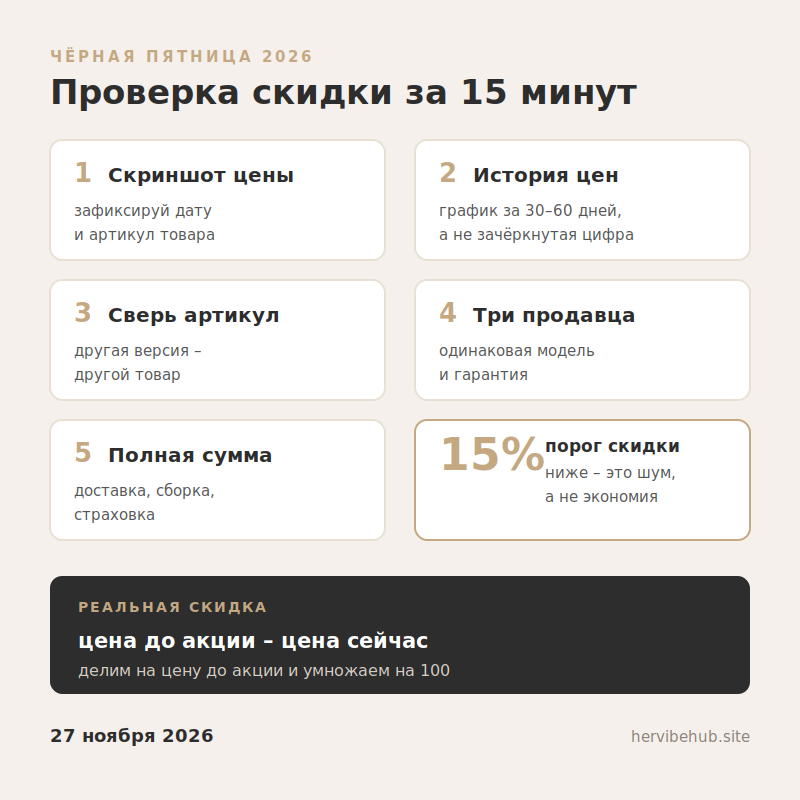
- Lock in the current price. Screenshot the product page with the date and SKU. This is your proof if the price “accidentally” changes a day later.
- Open the price history. Browser extensions collect daily price data automatically. If you don’t have one, check the product on aggregator sites — they often show a 30–90 day chart.
- Compare SKUs, not names. “Coffee Machine X 2000” and “Coffee Machine X 2000 with milk frother” are different products. The cheap offer often turns out to be a different version.
- Call or check three sellers. Same model, same warranty. If two out of three have a lower price than the “sale” price, the discount is fake.
- Calculate the total cost. Delivery 900 rubles, carrying upstairs 500 rubles, assembly 2,000 rubles, insurance. Sometimes “20% off” turns into a markup on the regular price.
The full sequence: screenshot → price history → SKU → three sellers → total with delivery. Five minutes for steps 1–3, ten for the rest.
Do this: start tracking the price 3–4 weeks before the sale, not on the day of the event.
Don’t do this: don’t trust a discount you’re seeing for the first time on a page with a countdown timer.
What Size Discount Actually Counts as a Discount?
A guideline based on real savings, not the number on the tag. The figures below come from price comparison practice, not advertising promises.
| Discount on the tag | Real savings | What to do |
|---|---|---|
| up to 15% | 0–5%, mostly noise | Wait calmly: this isn’t a reason to spend |
| 20–30% | 10–20% | Buy if the item was already on your list |
| 40–50% | 25–35% | Check the bundle contents and year of manufacture |
| 70% and above | usually a different model or old stock | Verify the SKU and production date |
The 15% threshold didn’t come out of nowhere. If a product goes up a few percent a year, a 10% discount just brings you back to last year’s price. Real savings start where the amount drops below what you paid before.
Do this: decide in rubles: “I’ll save 4,200 rubles” is clearer than “35% off.”
Don’t do this: don’t buy just because the percentage is big. A discount on something you don’t need is an expense, not a saving.
6 Sale Tricks and How to Check Each in a Minute
- “Only 2 left.” Open the page in incognito mode: if the counter is the same and appears on five other products — it’s decoration, not inventory.
- A 10-minute timer. Refresh the page. If the countdown restarted — there’s no rush.
- “Second item half price.” Divide the total by two. Often each item is cheaper individually from another seller.
- Free shipping over 5,000 rubles. Compare the shipping cost (400–600 rubles) with the amount you’re adding to reach the threshold. If you added 1,500 rubles — you paid 1,500 to save 500.
- “Price only with promo code.” Check whether the promo code applies to the item you want and whether it’s excluded from the promotion. The fine print at the bottom of the page takes 30 seconds to read.
- A “sale” on last season’s collection. For clothing, check the fabric composition and season. A display sample at 60% off may have signs of wear.
Do this: read the promotion terms before clicking “Buy.”
Don’t do this: don’t place an order when the page says “limited offer” without specific conditions.
A 7-Point Checklist Before Hitting “Pay”
- The item was on my list before the sale, not something that just appeared now.
- I know its regular price over the last 30 days.
- The SKU matches the model I compared.
- The total with delivery is lower than two other sellers’ prices.
- The warranty and return conditions are the same as for a regular purchase.
- I’m paying by card, not transferring money to a private individual’s account.
- I’m not taking out a loan or installment plan just for a discount.
Seven questions — two minutes. If even one answer is “no,” the purchase moves to tomorrow. Overnight, half of your urges disappear on their own.
How to Leave a Sale with Money Intact: A Limit and the 24-Hour Rule
The biggest loss on Black Friday isn’t overpaying for one item — it’s ten extra items. Set a limit before the sale, not after.
- A list of 5 items. No more. Anything not on the list doesn’t get bought, even at 70% off.
- A ruble limit for the entire sale. One number you don’t exceed. For example, 15,000 rubles. Count “how much is left of my limit,” not “how much I saved.”
- The 24-hour rule for any purchase over 5,000 rubles. Put it in the cart, close the tab, come back tomorrow. If you still want it — buy it.
- Unsubscribe from newsletters a week before the sale. Fewer emails — fewer reasons to open a store without needing to.
- Save the evidence. Screenshot the product page with the price, date, and SKU, plus the receipt and order number. Without this, the conversation will end at “we never had such prices.”
- Write to the seller in writing. Through the website form or by email: state that the pre-sale price was different, attach the screenshot, and ask to recalculate the cost or cancel the order.
- If you haven’t received the item yet — refuse it at delivery. For remote purchases, you have 7 days to return a product of proper quality, and if the return procedure wasn’t provided in writing — up to 3 months.
- File a complaint with Rospotrebnadzor. Price information must be accurate: Article 10 of the Consumer Protection Law explicitly requires this. Complaints are filed through the agency’s website, and a response usually comes within a month.
And a separate note on installment plans. “0% for 12 months” on an emotional purchase isn’t a discount — it’s a year-long commitment. Count how many such payments you already have.
What to Do If the Discount Turns Out to Be Fake
Step by step, without panic or hoping for a miracle.
The boundary: an inflated price isn’t a crime — a store has the right to set any price. The violation begins where false information about the discount was provided. That’s exactly what your screenshot documents.
Verified: Black Friday 2026 — November 27. Return and price information rules — RF Law “On Consumer Protection,” Art. 10 and Art. 26.1. Practice — personal shopping experience and price analysis on marketplaces, November 2026.
Frequently Asked Questions
When is Black Friday in 2026?
November 27. Major sales start around November 20–23, and some stores keep promotions running until the end of the month.
How long does it take to check one discount?
15 minutes: 5 minutes for price history and SKU, 10 minutes for comparing three sellers and the total cost with delivery.
Can I return an item bought on sale?
Yes. A discount doesn’t cancel buyer’s rights: for remote purchases — 7 days to return, and if the return procedure wasn’t provided in writing — up to 3 months. Exception — items from the non-returnable list, such as cosmetics and underwear.
Is the store obligated to refund money if the pre-sale price was inflated?
No, a high price by itself is legal. You can demand a recalculation if you were given false information about the discount size or promotion terms — in that case, file a complaint with Rospotrebnadzor.
What actually gets cheaper on Black Friday?
Electronics, last season’s items, display samples, leftover collections. Basic clothing lines and children’s goods often sell at regular prices disguised as promotions.
Is it worth buying New Year gifts in November?
Yes, if you have a list of recipients. Buying from a list saves 10–20%; buying “because it’s on sale” takes 100% of your budget.


